Breaking News

SAMA Introduces the S32 WOOD, a Compact M-ATX Case Bundled with an 80 PLUS Gold PSU Thypoch Completes Simera-C Cine Prime Lineup with New 100mm T1.9 Lens CORSAIR Launches the RM1200e Power Supply with Built-in PinProtect GPU Overcurrent Protection and Platinum-certified Efficiency CORSAIR Changes the Game with PureVector, a Science-Based Personalized Aiming Technology, Launching Exclusively in the SABRE v3 PRO PureVector Mouse Series AMD FSR Upscaling 4.1 Boosts Frames and Image Quality on More Devices

logo

  • Share Us
    • Facebook
    • Twitter
  • Home
  • Home
  • News
  • Reviews
  • Essays
  • About
    • Submit News

    • Contact Us
    • Privacy

    • Promotion
    • Advertise

    • RSS Feed

Search form

Google Wants To Remove The VR headset

Google Wants To Remove The VR headset

Enterprise & IT Feb 22,2017 0

Google's researchers have used a headset removal technology to enhance Mixed Reality, allowing the medium to not only convey a VR user's interaction with the virtual environment but also show their face in a natural fashion.

Virtual reality lets you experience amazing things - from exploring new worlds, to painting with trails of stars, to defending your fleet to save the world. However, if you're watching someone else use VR, it's hard to tell what's going on and what they're seeing. And if you're in VR with someone else, there aren't easy ways to see their facial expressions without an avatar representation.

Daydream Labs and Google Research teamed up to start exploring how to solve these problems. Using a combination of machine learning, 3D computer vision, and advanced rendering techniques, the researchers are now able to "remove" headsets and show a person's identity, focus and full face in mixed reality. Mixed reality is a way to convey what's happening inside and outside a virtual place in a two dimensional format.

Using a calibrated VR setup including a headset (like the HTC Vive), a green screen, and a video camera, combined with accurate tracking and segmentation, you can see the "real world" and the interactive virtual elements together.

The first step to removing the VR headset is to construct a dynamic 3D model of the person's face, capturing facial variations as they blink or look in different directions. This model allows us to mimic where the person is looking, even though it's hidden under the headset.
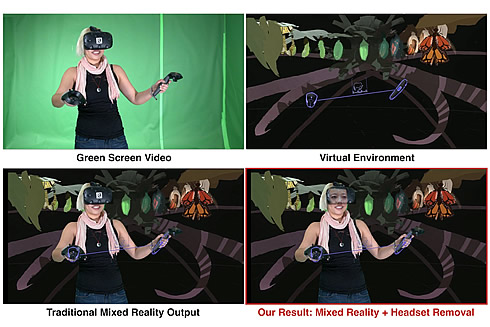
Next, the researchers use an HTC Vive, modified by SMI to include eye-tracking, to capture the person's eye-gaze from inside the headset. From there, they create the illusion of the person's face by aligning and blending the 3D face model with a camera's video stream. A translucent "scuba mask" look helps avoid an "uncanny valley" effect.

Finally, the researchers composite the person into the virtual world, which requires calibrating between the Vive tracking system and the external camera. The end result is a complete view of both the virtual world and the person in it, including their entire face and where they're looking.

Headset removal is poised to enhance communication and social interaction in VR itself with diverse applications like VR video conference meetings, multiplayer VR gaming, and exploration with friends and family.

Tags: vr headsets
Previous Post
AMD Launches Ryzen PC Chips, With A Price And Performance That Could Threaten Intel
Next Post
Toshiba Starts Sampling 64-Layer, 512-gigabit 3D Flash Memory

Related Posts

  • Possible Oculus Quest 2 Details Leak

  • Lenovo Mirage VR S3 Standalone Headset with ThinkReality Released

  • HP, Valve, and Microsoft Present the Reverb G2 Virtual Reality Headset

  • Former HTC Boss Peter Chou Releases the XRSPACE 5G VR Headset

  • Oculus Said to Develop Lighter Version of the Quest VR Headset

  • HP Teases With New VR Headset Made With Microsoft and Valve

  • HTC Unveils New Vive Cosmos VR Lineup, 'Project Proton' Prototypes

  • JDI Starts Mass Production of 1058 ppi High-Definition VR LCD

Latest News

SAMA Introduces the S32 WOOD, a Compact M-ATX Case Bundled with an 80 PLUS Gold PSU
Enterprise & IT

SAMA Introduces the S32 WOOD, a Compact M-ATX Case Bundled with an 80 PLUS Gold PSU

Thypoch Completes Simera-C Cine Prime Lineup with New 100mm T1.9 Lens
Cameras

Thypoch Completes Simera-C Cine Prime Lineup with New 100mm T1.9 Lens

CORSAIR Launches the RM1200e Power Supply with Built-in PinProtect GPU Overcurrent Protection and Platinum-certified Efficiency
PC components

CORSAIR Launches the RM1200e Power Supply with Built-in PinProtect GPU Overcurrent Protection and Platinum-certified Efficiency

CORSAIR Changes the Game with PureVector, a Science-Based Personalized Aiming Technology, Launching Exclusively in the SABRE v3 PRO PureVector Mouse Series
Gaming

CORSAIR Changes the Game with PureVector, a Science-Based Personalized Aiming Technology, Launching Exclusively in the SABRE v3 PRO PureVector Mouse Series

AMD FSR Upscaling 4.1 Boosts Frames and Image Quality on More Devices
GPUs

AMD FSR Upscaling 4.1 Boosts Frames and Image Quality on More Devices

Popular Reviews

Endorfy Thock V2 Wireless Keyboard

Endorfy Thock V2 Wireless Keyboard

SoundPeats Cove Pro

SoundPeats Cove Pro

The Quiet Technology Behind the Spin

The Quiet Technology Behind the Spin

Akaso Brave 8 Lite

Akaso Brave 8 Lite

SoundPeats C30

SoundPeats C30

Kioxia Exceria Plus G3 512GB microSD

Kioxia Exceria Plus G3 512GB microSD

be quiet! Dark Perk Mice

be quiet! Dark Perk Mice

XbotGo Chamaleon

XbotGo Chamaleon

Main menu

  • Home
  • News
  • Reviews
  • Essays
  • About
    • Submit News

    • Contact Us
    • Privacy

    • Promotion
    • Advertise

    • RSS Feed
  • About
  • Privacy
  • Contact Us
  • Promotional Opportunities @ CdrInfo.com
  • Advertise on out site
  • Submit your News to our site
  • RSS Feed