Breaking News

SAMA Introduces the S32 WOOD, a Compact M-ATX Case Bundled with an 80 PLUS Gold PSU Thypoch Completes Simera-C Cine Prime Lineup with New 100mm T1.9 Lens CORSAIR Launches the RM1200e Power Supply with Built-in PinProtect GPU Overcurrent Protection and Platinum-certified Efficiency CORSAIR Changes the Game with PureVector, a Science-Based Personalized Aiming Technology, Launching Exclusively in the SABRE v3 PRO PureVector Mouse Series AMD FSR Upscaling 4.1 Boosts Frames and Image Quality on More Devices

logo

  • Share Us
    • Facebook
    • Twitter
  • Home
  • Home
  • News
  • Reviews
  • Essays
  • About
    • Submit News

    • Contact Us
    • Privacy

    • Promotion
    • Advertise

    • RSS Feed

Search form

Virgin Galactic SpaceShipTwo Reaches 'Space' For The First Time

Virgin Galactic SpaceShipTwo Reaches 'Space' For The First Time

Enterprise & IT Dec 13,2018 0

Virgin Galactic has just reached one of the biggest milestones in its history – its first test flight to space.

VSS Unity, the company's space plane, took off in the early morning December 13 from the Mojave Air and Space Port in California. The space plance was carried into the air by a larger aircraft called WhiteKnightTwo, or VMS Eve.

At about 13,000 meters (43,000 feet) in altitude, VSS Unity was dropped from its mothership, when it powered on its rocket motor and soon reached a supersonic speed of Mach 2.9. Just a minute later, it reached the highest point of its flight – 82.7 kilometers (51.4 miles) above the surface of Earth – reaching for the first time what the company considers the boundary of space. Then, the space plane safely re-entered Earth’s atmosphere. VSS Unity returned to the runway at 8.14am local time, with the flight from the drop to the landing lasting 14 minutes in total.
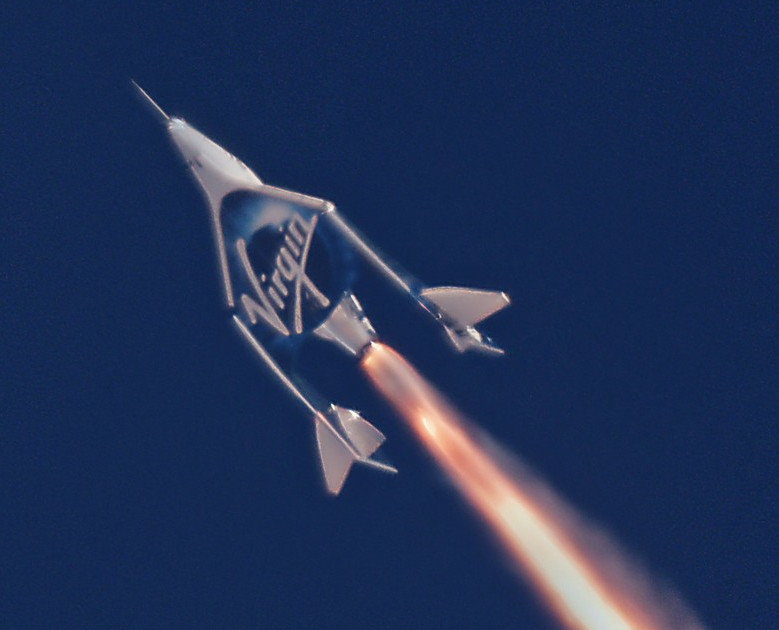
The VSS Unity's previous maximum altitude, on July 26, 2018, reached a height of 52 kilometers (32 miles), with a previous top speed record of Mach 2.4.

VSS Unity was built by Virgin Galactic’s sister company, The Spaceship Company. The aircraft is powered by a hybrid rocket motor, using both solid and liquid rocket engines.

Virgin Galactic's development of its spaceship took far longer than expected and endured a setback when the first experimental craft broke apart during a 2014 test flight, killing the co-pilot.

Virgin hopes that future flights will have up to six paying customers ($250,000 a ticket) onboard. When VSS Unity makes these flights in future, it will target up to six minutes in microgravity, with the passengers able to get out of their seats and float around.

During descent, the craft's twin tails are designed to rotate upward to slow it down, then return to a normal flying configuration before the craft glides to a landing on a runway.

Virgin Galactic isn't alone in the space tourism business: Jeff Bezos' Blue Origin is planning to take space tourists on trips, using the more traditional method of a capsule atop a rocket that blasts off from a launch pad. SpaceX's Elon Musk recently announced plans to take a wealthy Japanese entrepreneur and his friends on a trip around the moon.

Tags: Virgin
Previous Post
YouTube Removed 58 million Videos in Quarter
Next Post
New AMD Radeon Software Adrenalin 2019 Edition Brings Performance-boosting Features

Related Posts

  • Virgin Media Reports Data Incident

  • Virgin to Unveil Portable Music Player

Latest News

SAMA Introduces the S32 WOOD, a Compact M-ATX Case Bundled with an 80 PLUS Gold PSU
Enterprise & IT

SAMA Introduces the S32 WOOD, a Compact M-ATX Case Bundled with an 80 PLUS Gold PSU

Thypoch Completes Simera-C Cine Prime Lineup with New 100mm T1.9 Lens
Cameras

Thypoch Completes Simera-C Cine Prime Lineup with New 100mm T1.9 Lens

CORSAIR Launches the RM1200e Power Supply with Built-in PinProtect GPU Overcurrent Protection and Platinum-certified Efficiency
PC components

CORSAIR Launches the RM1200e Power Supply with Built-in PinProtect GPU Overcurrent Protection and Platinum-certified Efficiency

CORSAIR Changes the Game with PureVector, a Science-Based Personalized Aiming Technology, Launching Exclusively in the SABRE v3 PRO PureVector Mouse Series
Gaming

CORSAIR Changes the Game with PureVector, a Science-Based Personalized Aiming Technology, Launching Exclusively in the SABRE v3 PRO PureVector Mouse Series

AMD FSR Upscaling 4.1 Boosts Frames and Image Quality on More Devices
GPUs

AMD FSR Upscaling 4.1 Boosts Frames and Image Quality on More Devices

Popular Reviews

Endorfy Thock V2 Wireless Keyboard

Endorfy Thock V2 Wireless Keyboard

SoundPeats Cove Pro

SoundPeats Cove Pro

The Quiet Technology Behind the Spin

The Quiet Technology Behind the Spin

Akaso Brave 8 Lite

Akaso Brave 8 Lite

SoundPeats C30

SoundPeats C30

Kioxia Exceria Plus G3 512GB microSD

Kioxia Exceria Plus G3 512GB microSD

be quiet! Dark Perk Mice

be quiet! Dark Perk Mice

XbotGo Chamaleon

XbotGo Chamaleon

Main menu

  • Home
  • News
  • Reviews
  • Essays
  • About
    • Submit News

    • Contact Us
    • Privacy

    • Promotion
    • Advertise

    • RSS Feed
  • About
  • Privacy
  • Contact Us
  • Promotional Opportunities @ CdrInfo.com
  • Advertise on out site
  • Submit your News to our site
  • RSS Feed