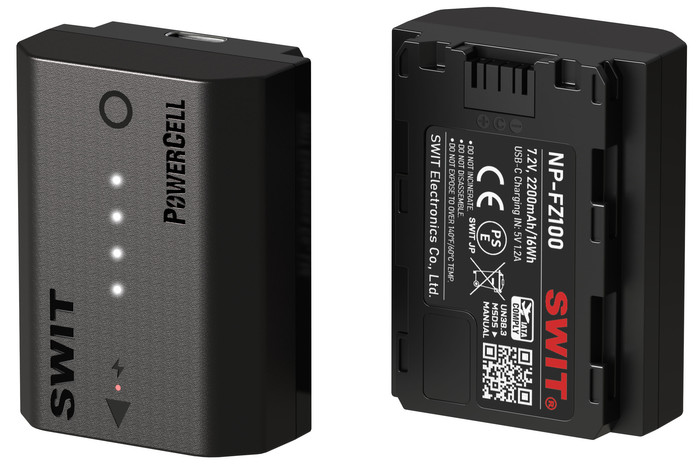
Swit NP-FZ100 Battery
4. Conclusion
Price and Value — €49 vs. the Original
At €49, the SWIT PowerCell NP-FZ100 sits at roughly 60–70% of the cost of a genuine Sony battery, which currently retails at around €68–83 across European markets depending on retailer. That's a saving of €20–35 per unit — meaningful when you're buying two or three batteries for a production kit.
What makes the pricing comparison interesting is what you're giving up and what you're gaining. On the giving-up side: the original Sony battery has 2280mAh versus the SWIT's 2200mAh, an 80mAh difference that is functionally negligible in real-world shooting. Sony's InfoLITHIUM system is also present in the SWIT via its full decode, so you lose nothing on camera communication or charge display accuracy.
On the gaining side: the SWIT adds USB-C charging, which the original Sony battery does not have at any price. It also comes with a more detailed five-state LED indicator compared to the original's simpler readout, and a certification dossier — CE, PSE, UN38.3 — that the genuine Sony battery doesn't publish in the same transparent, document-by-document format.
The competitive landscape matters here too. Many third-party NP-FZ100 batteries trigger error messages, fail to provide accurate charge readouts, or develop swelling and reliability issues over time. Budget alternatives at €15–20 may look appealing but carry real risks on professional jobs. The SWIT at €49 occupies a different tier entirely — priced between throwaway generics and the genuine article, but with engineering and compliance credentials that put it closer to the latter category.
For a Sony shooter building out a battery set, the practical calculus is straightforward: two SWIT PowerCells cost €98, versus €136–165 for two original Sony batteries. The saving funds a third SWIT battery with change to spare — and that third battery, with its USB-C port, becomes your location top-up unit while the other two cycle through the deck charger.
Verdict
The SWIT PowerCell NP-FZ100 does what most third-party batteries only claim to do. Full Sony decode, accurate charge display, premium cells, V0 housing, and a certification suite that will satisfy broadcast and rental house compliance requirements — it covers every professional box. The USB-C charging is a genuine differentiator over the original Sony battery, even if our real-world testing clocked nearly five hours to a full charge rather than the manual's 3.5-hour figure. The flat, stable current profile throughout that test is the more important result: this is a protection circuit that behaves itself, with no thermal events, no current hunting, and a clean termination. For location shooters, the ability to top up from a power bank or V-mount USB-C port without carrying a dedicated charger is worth the slower rate.
Where it asks something of you in return: storage discipline. Follow the 50–90% long-term storage recommendation, reactivate every six months, and use a proper charger for primary cycling. Do those things and there's no reason this battery shouldn't outlast several cheaper alternatives.
For Sony shooters who want third-party power they can genuinely rely on — in the camera, in the air freight documentation, and on set — the PowerCell NP-FZ100 is the one to buy.