Swit NP-FZ100 Battery
3. Tests
Camera Communication
This is where many third-party batteries fall down, and the PowerCell doesn't. It's fully decoded — the manual's term for full authentication with Sony's battery management system. The camera reads capacity, discharging curve, and percentage accurately, identical to the original, with no pop-up alerts or "use original battery" warnings. The discharge curve is described as completely identical to Sony's original, so what you see on your camera's battery indicator accurately reflects remaining capacity throughout the full cycle. For professional shooters managing long recording sessions, this matters enormously.
Charging
The battery supports two charging methods: original Sony deck charger (BC-QZ1 or BC-ZD1) and USB-C direct input at 5V/1.2A. SWIT also lists the UC-2065 as a compatible SWIT charger. Reference charging times from the manual: 8.4V/2A via deck charger takes approximately 1.5 hours. USB-C at 5V/1A takes approximately 3.5 hours per SWIT's published figure.
The USB-C charging test was conducted using a Baseus GaN3 Pro 100W GaN desktop charger connected via a Nimaso 100W-rated USB-C cable into the battery's USB-C port, with no other devices connected. Per the GaN3 Pro's port allocation chart, a single device on the C2 port alone receives the full 100W output — meaning the charger was offering 100W USB PD with access to all standard PD voltage profiles (9V, 12V, 15V, 20V) throughout the test.
Real-world USB-C test results tell a different story. Measured using a Power-Z USB meter capturing VBUS voltage, current (IBUS), and D+/D- data lines throughout a full charge cycle from near-empty, the battery took 4 hours 45 minutes 46 seconds to reach full charge, delivering 3.8769 Ah and 19.485 Wh over 17,147 logged data points.
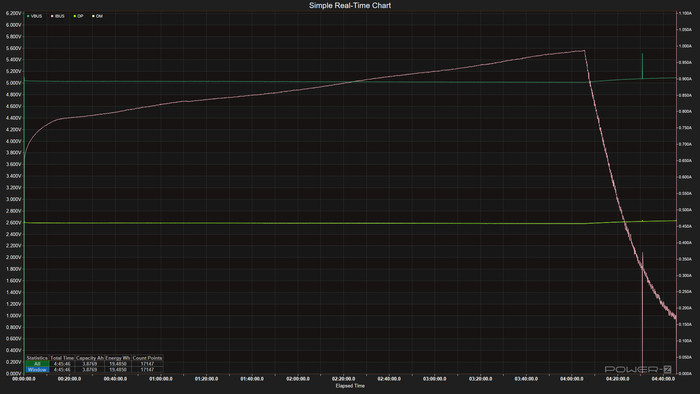
The charge curve is well-behaved. VBUS starts around 4.0V and climbs gradually through the first 20 minutes as the charger negotiates with the battery's protection circuit, settling around 4.4V before rising slowly and consistently through the long middle phase, peaking at approximately 5.5V near the 4-hour mark. Current holds extremely flat at around 0.900A for virtually the entire session — a textbook constant-current profile with no fluctuations or thermal throttling events. The termination event is clean: VBUS collapses sharply and current drops away as the battery signals full charge and the charger cuts off. The brief IBUS spike at termination is a normal protection circuit switching artefact. The SWIT PowerCell's onboard charging circuit does not negotiate any USB PD voltage step-up whatsoever. It accepts 5V and nothing else, regardless of what the source offers. This is a deliberate design constraint — the 5V input is the battery's native USB-C charging ceiling, and the intelligent thermal control circuitry operates entirely within that envelope.
The 19.485 Wh delivered exceeds the battery's rated 16 Wh, which is expected — lithium-ion charging carries 15–25% overhead from heat losses and protection circuit operation. The flat current profile throughout confirms the protection circuit is stable and well-engineered.
Practically speaking, a basic 5W USB-C charger would deliver exactly the same charging power to this battery as the Baseus GaN3 Pro's 100W C2 port. The only relevant charger specification for direct USB-C battery charging is stable 5V delivery under sustained load — something any quality charger provides trivially. The GaN3 Pro does this without voltage droop, but its additional capability is simply unused by this load.
The cable rating is similarly irrelevant for this use case. The Nimaso 100W cable is capable of carrying up to 5A at 20V — far beyond what 5V/0.9A demands. Any USB-C cable rated to carry 1A reliably would perform identically here.
Practical implication: budget five hours from flat for USB-C charging rather than SWIT's published 3.5 hours. The USB-C port is best treated as an overnight or long-break convenience rather than a quick between-take solution. That said, the ability to charge from any USB-C power bank, V-mount with USB-C output, or wall adapter remains genuinely useful for location work where a deck charger isn't practical.
Compatible Chargers
The manual formally lists Sony BC-QZ1 and BC-ZD1, and SWIT's UC-2065. The spec sheet notes the listed compatible camera models are not exhaustive — verify against your specific body before purchasing if it isn't on the main list.
The Sony BC-ZD1 is Sony's current dual-bay charger for the NP-FZ100, and the SWIT PowerCell is fully compatible with it — the BC-ZD1 is one of the two Sony chargers explicitly listed in the manual alongside the older BC-QZ1.
The BC-ZD1 charges two NP-FZ100 batteries simultaneously in approximately 155 minutes when connected to a USB PD-compatible power supply of 30W or higher. That's a meaningful step up from the older BC-QZ1's single-bay design, and for shooters running two PowerCell batteries through a heavy day, it makes overnight turnaround essentially a non-issue.
One important operational note: the charge lamp turns off when battery charge level exceeds 90% (operational charge). Charging must continue for another 30 minutes to achieve a full charge. This is worth knowing because if you pull batteries when the LED extinguishes, you're actually at 90%, not 100% — which explains why some users report slightly shorter-than-expected runtimes from deck chargers.
The BC-ZD1 features temperature monitoring and control built in, with heat dissipation designed specifically for the NP-FZ100 form factor. Since the SWIT PowerCell matches the original battery's dimensions and discharge curve exactly, the thermal management will function just as designed — the charger has no way to distinguish the SWIT cell from a genuine Sony one, and doesn't need to.
The BC-ZD1 requires a USB PD-compatible power supply capable of 30W or higher, with a USB-C cable that can support 3A or higher current — neither is included in the box. If you're pairing the BC-ZD1 with the SWIT PowerCell, factor that into the kit cost: a quality 30W+ USB-C PD charger is an additional €20–30 if you don't already own one.
The charger has a compact, flat low-profile design measuring 84.5 × 29.2 × 70mm, making it easy to slip into a camera bag alongside the batteries. For a two-battery SWIT kit, the BC-ZD1 is the logical pairing: both batteries back to full in under three hours, with Sony's own thermal management doing the work. The USB-C input on the charger also means a single 30W+ PD brick can power both the charger and other USB-C devices on location.
In short: the BC-ZD1 and SWIT PowerCell are a clean match. The SWIT is fully authenticated, fits correctly, and will charge at the same rate and to the same endpoint as a genuine Sony battery in the same charger.
Sony NP-FZ100 vs SWIT PowerCell NP-FZ100 — Head-to-Head on the Sony BC-ZD1
Both batteries were tested on the Sony BC-ZD1 charger under identical conditions, with a Power-Z KM003C USB meter logging VBUS, current, power, and temperature at 1 sample per second throughout each complete charge cycle from empty to termination.
The SWIT PowerCell completed its charge cycle in 2 hours 1 minute 2 seconds.
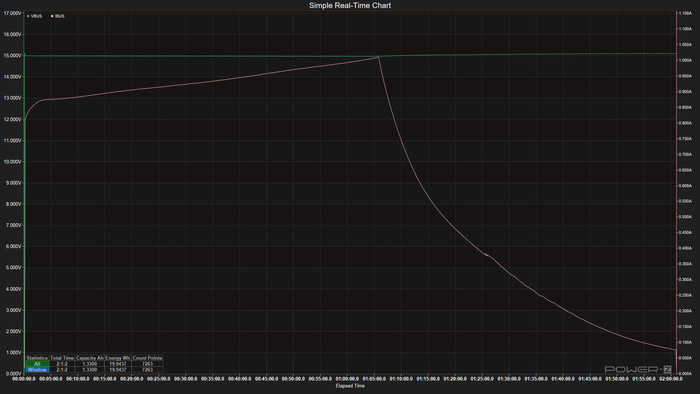
The genuine Sony NP-FZ100 took 2 hours 8 minutes 19 seconds — 7 minutes longer.
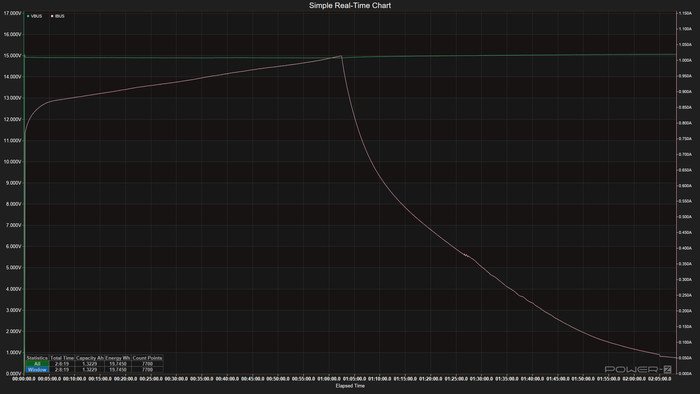
Counter to what the capacity difference (2200mAh SWIT vs 2280mAh Sony) might suggest, the SWIT actually terminated earlier. The reason is visible in the taper data: the SWIT's CV phase decays slightly faster, reaching the termination current threshold sooner. In practical terms the difference is negligible, but it confirms the SWIT is not disadvantaged in any way on the BC-ZD1.
Both batteries negotiate a 15V USB PD profile with the BC-ZD1 immediately on connection. The startup ramp differs slightly: the Sony begins at 11.66W at 30 seconds and climbs gradually to ~13.93W average across the CC phase, while the SWIT starts higher at 12.31W at 30 seconds and averages ~13.98W — marginally more assertive in its initial power acceptance, suggesting a fractionally lower internal resistance at the start of the cycle. Both reach peak current around the 1-hour mark: Sony at 1.0143A (62 minutes 26 seconds), SWIT at 1.0097A (65 minutes 49 seconds). The difference is 0.5% — functionally identical.
The transition from constant-current to constant-voltage charging is the most revealing moment in any charge cycle, as it indicates how full the battery was when the bulk phase ended. Sony's transition occurs at approximately 14.29 Wh / 0.959 Ah delivered. SWIT's occurs at 15.15 Wh / 1.012 Ah delivered — the SWIT pushes its CC phase approximately 6% further before transitioning, meaning it arrives at the CV taper point with slightly more energy already stored. Both batteries then taper cleanly with no steps or renegotiation events.
The taper profiles are nearly indistinguishable in shape. Five minutes after transition, both batteries are at approximately 0.717–0.718A. By 30 minutes into the taper, Sony is at 0.313A and SWIT at 0.251A — the SWIT decaying slightly faster, consistent with its earlier termination. The taper curves track each other closely enough to confirm the BC-ZD1 is running an identical charge algorithm on both batteries, with no adaptation or compensation for cell differences.
Sony peaked at 32.73°C at 62 minutes 35 seconds. SWIT peaked at 33.37°C at 68 minutes 14 seconds — a 0.64°C difference at peak, occurring slightly later in the cycle. Both end the session well below 31°C as the taper reduces heat generation. The 0.64°C delta is within normal cell-to-cell variation and presents no operational concern. Both results are excellent — a battery completing a fast charge cycle below 34°C is a direct demonstration of the BC-ZD1's thermal management working as designed.
Sony: 19.745 Wh total at the charger input. SWIT: 19.944 Wh — marginally more, consistent with the longer CC phase before taper. Both figures represent approximately 20–22% overhead above the batteries' rated energy (16Wh and 16.4Wh respectively), reflecting charger conversion losses and protection circuit operation. This is normal and expected for lithium-ion charging.
Measured across every parameter — charge time, peak current, CC/CV transition, taper profile, temperature, and total energy — the SWIT PowerCell and genuine Sony NP-FZ100 behave as near-identical loads on the BC-ZD1. The charger runs the same algorithm on both without adaptation. The SWIT finishes 7 minutes faster, runs 0.64°C warmer at peak, and delivers a marginally deeper CC phase before taper. None of these differences have any practical significance in the field. For BC-ZD1 users, the SWIT PowerCell is a drop-in replacement in every measurable sense.