Why Intelligent Firmware Matters More Than Peak Throughput in NAS Systems
Network Attached Storage (NAS) systems have come a long way from their origins in simple file storage. Today, in homes, businesses and creative environments around the world, NAS takes on a much broader role, supporting multiple users and processes simultaneously, often around the clock.
When assessing hard drives, headline specifications such as capacity and transfer speed are obvious points of comparison. But a NAS rarely gives a drive the clean, uninterrupted workload represented by a peak sequential-transfer figure. In reality, NAS operation involves backups, file access, metadata, RAID activity and other requests competing with one another.
Consequently, NAS performance isn't determined by the mechanical hardware or headline throughput alone. How effectively the drive manages these competing workloads can be just as important, and this is where firmware plays a crucial role. To understand why, it is useful to consider what headline transfer-speed figures actually represent.
Why peak throughput only tells part of the story
The sequential transfer rate quoted for a hard drive describes one particular operating condition: moving data continuously between neighbouring sectors. During a sustained sequential transfer, the recording heads spend relatively little time seeking between different locations on the media. A NAS rarely operates under those conditions for long. As different requests arrive, continuous transfers are interrupted and the recording heads begin moving between different parts of the disk.
In a four-bay NAS during the working day, overnight backups may still be completing while users access shared files and the operating system updates filesystem metadata. If one drive has recently been replaced, RAID rebuild traffic joins the same queue of requests. None of these activities is especially demanding on its own. The difficulty comes from servicing them all at the same time.
The result is not simply lower throughput, as every change of direction interrupts the flow of data and introduces additional head movement before the next request can be serviced. As more requests arrive, continuous data transfer becomes increasingly fragmented by other activity.
Not every request can wait, although delaying part of a sequential backup by a fraction of a second is rarely noticeable. A user opening a document expects an immediate response, while filesystem metadata and RAID rebuild traffic must continue to make progress in the background. The drive has to balance read and write requests that differ in size, location and urgency rather than processing them strictly in the order they arrive.
Firmware optimizes hardware behaviour
The recording heads, spindle motor and recording media define the mechanical limits of a hard drive. Firmware cannot make those components operate faster, but it can determine how efficiently they are used. It determines how the drive responds to different requests, including how data is managed in the cache and how commands are organised before they are executed.
Two drives built from similar hardware can therefore respond differently to the same NAS workload. The difference lies not in the recording mechanism itself, but in the firmware controlling it.
The workload determines the response
In this same four-bay NAS, the overnight backup is still writing when a user opens a document stored elsewhere on the array. The drive could interrupt the backup immediately to service the read request, but that would increase head movement and break the continuous write stream. Ignoring the read request is no better because the user expects an immediate response. The firmware therefore has to decide how those competing requests should be handled before either reaches the recording mechanism.
That decision depends on more than the order in which requests arrive. A read request may deserve a different response from a long sequential write, while metadata updates and RAID rebuild traffic introduce further demands on the storage system. As the workload changes, the firmware continually reassesses how incoming requests should be handled before they reach the recording mechanism, so it can determine how the cache should be used and how commands should be organised.
Cache allocation depends on workload
Recognising the workload is only the first step. Once the firmware has determined how a request should be handled, it can apply a cache policy that reflects the demands of that activity rather than treating every request in the same way.
A sequential backup and a user opening a document may both pass through the same cache, but they do not benefit from the same allocation strategy. Reserving cache space for buffered writes helps maintain the continuity of a sequential transfer, while making cache available for read requests reduces the time spent waiting for data to be retrieved.
Applying a single cache policy to every request can cause buffered sequential writes and smaller read requests to compete for the same cache resources as the workload changes.
Command scheduling applies those decisions
Recognising the workload and allocating cache appropriately does not determine when requests reach the recording media. The firmware must still decide the order in which pending commands are executed. In a mixed NAS workload, that decision influences how often the recording heads move between different locations on the disk and how much time is spent transferring data rather than repositioning the recording mechanism.
The principles described so far are implemented in different ways by different drive manufacturers. Toshiba’s approach is embodied in its NASLink™ firmware architecture, where workload recognition, cache allocation and command scheduling operate as parts of the same decision-making process (Figure 1).
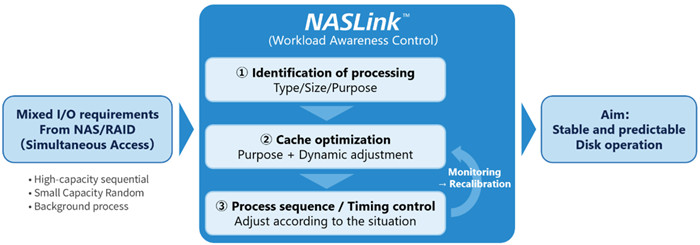
Figure 1: Firmware first identifies the workload before applying cache allocation and command scheduling for ‘predictable’ performance
Within NASLink™, the recognised processing type influences how pending commands are organised. Small write requests are grouped into longer, more continuous write sequences to reduce unnecessary head movement. Small read requests are inserted during gaps in writing activity where possible, while background operations such as RAID rebuilds and disk checks are adjusted to reduce their effect on foreground user access.
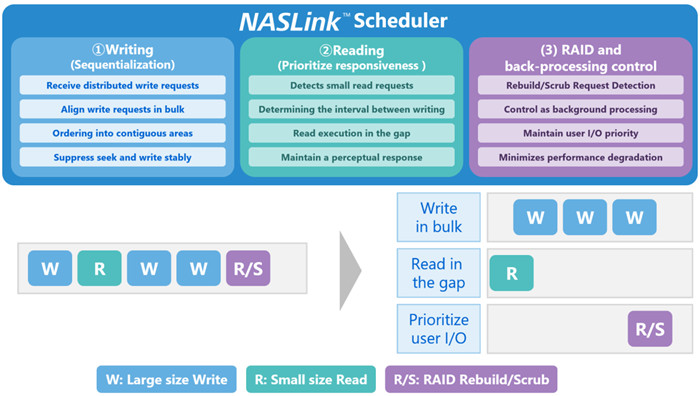
Figure 2: NASLink™ reorganises pending requests by grouping writes into longer sequential transfers, servicing smaller reads during suitable intervals and managing RAID background activity separately
Scheduling decisions also consider factors beyond the command itself. Queue length, data continuity, vibration and temperature all contribute to the order in which requests are executed.
Firmware still depends on the hardware
The firmware can recognise workloads, allocate cache and organise the command queue, but those decisions still rely on the physical characteristics of the drive. The recording technology determines how data is written to the media, the available cache limits the memory the firmware can work with, and accurate head positioning remains essential when commands are executed.
This is why NAS firmware is developed alongside hardware designed for continuous multi-drive operation rather than in isolation. In the Toshiba N300, Conventional Magnetic Recording (CMR) provides the predictable sequential recording characteristics assumed by the firmware strategy, up to 1 GB of cache provides the working memory that NASLink™ allocates dynamically, and rotational vibration sensors help maintain accurate head positioning when neighbouring drives introduce vibration into the enclosure.
Engineering for mixed workloads
Peak sequential throughput remains an important specification, but it describes only one operating condition. A NAS drive spends much of its life responding to competing requests that interrupt continuous data transfer and require the firmware to make decisions about how storage activity is organised.
NAS workloads combine sequential transfers, random reads and background maintenance activity in ways that place much of the drive's behaviour under firmware control. Workload recognition, cache allocation and command scheduling all influence how the recording mechanism responds to these competing demands, while the hardware provides the stable platform on which those decisions depend. Toshiba’s NASLink™ demonstrates one implementation of these engineering principles in a drive designed specifically for NAS environments.
By Eun-Kyung Hong, HDD Product Manager at Toshiba Electronics Europe GmbH