32x CD-RW Roundup Vol2
1. Introduction
Review Pages
2. Introduction - Page 2
3. Data Tests
4. CloneCD reading Tests
5. DAE Tests
6. CDR Tests - Page 1
7. CDR Tests - Page 2
8. Writing Quality of AOpen
9. Writing Quality of CyberDrive
10. Writing Quality of Philips
11. RW-Packet Writing Tests
12. Conclusion
13. CDR Tests - Page 3
14. Introduction - Page 3
32x CD-RW Roundup Vol 2 - Page 1
Which one is the faster?
- Introduction
In our first "32x CD-RW Roundup" we examined how three 32x recorders from LiteOn, Freecom and Mitsumi performed. After 40days new firmware revisions for LiteOn, Mitsumi drives released and new drives arrived from Philips, AOpen and CyberDrive. In this roundup we will examine if performance for LiteOn/Mitsumi drives have been improved and how the new drives perform.
- AOpen CRW3248
 The
drive supports 32x writing (Z-CLV), 12x re-writing, 8MB Buffer, "JustLink"
as the main anti-buffer under run technology and "JustSpeed" as the
media protection system. The maximum reading speed of the drive is 48x (CAV)
making it the faster ever recorder, at least at the reading part. The exact
writing speeds are 4x, 8x, 12x (CLV), 16x, 20x (16-20x), 24x (16-24x), 28x (16-28x)
and 32x (16-32x) (Z-CLV). The re-writing speeds are 4x, 8x, 10x and 12x (CLV).
The
drive supports 32x writing (Z-CLV), 12x re-writing, 8MB Buffer, "JustLink"
as the main anti-buffer under run technology and "JustSpeed" as the
media protection system. The maximum reading speed of the drive is 48x (CAV)
making it the faster ever recorder, at least at the reading part. The exact
writing speeds are 4x, 8x, 12x (CLV), 16x, 20x (16-20x), 24x (16-24x), 28x (16-28x)
and 32x (16-32x) (Z-CLV). The re-writing speeds are 4x, 8x, 10x and 12x (CLV).
The drive's official specifications state that the drive will come with 2MB buffer and Mt. Rainier format. The current 0.98e firmware revision doesn't support "Mt. Rainier" format. We assume that newer firmware revisions may support this feature. Ending, the drive supports all known writing modes (DAO, SAO, TAO and RAW).

- AOpen's 32x writing speed
The AOpen CRW3248 supports 32x writing speed using the Z-CLV writing technology. Below is the Nero CD Speed writing graph which illustrates the use of Zone-CLV writing technology:

The 32x writing speed range is divided into 5 zones: The drive starts writing at 16x from lead-in till the 6mins, shifts up to 20x at 10mins, shifts to 24x at 22mins, 28x at 36mins and lastly shifts to 32x at 52mins and stays there until the end of the burning process. The average recording speed is 25.49X and it seems that it is the slower 32x recorder among the five drives tested.
- The package
 The
package supplied contained: the drive itself, 1 piece of AOpen 80min 32x CD-R
blank (actual manufacturer Ritek), 1 piece of AOpen 80min 4-12x HS-RW blank
(actual manufacturer Plasmon), audio cable and mounting screws. The software
supplied with the drive was Nero Burning ROM v5.5.6.1 and Ahead InCD v3.17 (for
packet writing use).
The
package supplied contained: the drive itself, 1 piece of AOpen 80min 32x CD-R
blank (actual manufacturer Ritek), 1 piece of AOpen 80min 4-12x HS-RW blank
(actual manufacturer Plasmon), audio cable and mounting screws. The software
supplied with the drive was Nero Burning ROM v5.5.6.1 and Ahead InCD v3.17 (for
packet writing use).
We don't know yet if the AOpen CRW3248 comes with a 2-year warranty (only in Europe) or not. Lastly as the package says the drive is "XP" compatible which was confirmed from our test results, since the drive worked without any problems at UDMA-33 mode.
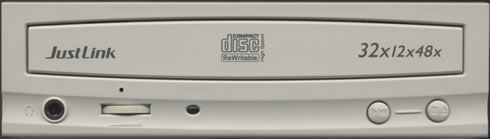
The front of the drive is not different from what we have used to see by Aopen . The drive doesn't have the AOpen logo printed on it. It includes the "High-Speed RW" and the "JustLink" logos. User will understand directly the drive's specs from the "32x12x48x" logo. You will also find only one led, the eject and next buttons and the headphone input jack/volume selector:
At the backside of the drive we will find the usual connectors (IDE interface, power), the jumpers for making the drive Master/Slave, the SPDIF output connector, the analog/digital output connectors and 3 jumpers which are used to setup the drive's working mode, PIO-4Mode (default) or UDMA33. For setting up the UDMA33 mode you just have to remove the middle jumper:

- Installation
 The
AOpen CRW3248 was installed as a Master in the secondary IDE BUS. The drive
worked in UDMA33 mode and after booting, identified itself as "AOPEN CD-RW
CRW3248". We used WinXP for the recording, reading tests and the DMA was
automatically enabled.
The
AOpen CRW3248 was installed as a Master in the secondary IDE BUS. The drive
worked in UDMA33 mode and after booting, identified itself as "AOPEN CD-RW
CRW3248". We used WinXP for the recording, reading tests and the DMA was
automatically enabled.
The drive was a January 2002 model with firmware revision v0.98e installed. We used the newer build of Nero (5.5.7.2), InCD (3.21), and CloneCD (3.3.4.1) for our recording tests.
As the following Nero screenshot shows, the drive supports JustLink and JustSpeed functions. For our tests, JustSpeed was disabled since with the most of our 24x/32x media, the drive automatically reduces speed down to 16x. This happens due to the drive's early firmware revision. With newer firmware updates, more media will be supported. From our tests, with Ricoh/Mitsui 24x media we were able to record at 32x. Others (like TaiyoYuden/Mitsubishi Chemicals) were only recognized as 16x (with JustSpeed enabled):

Review Pages
2. Introduction - Page 2
3. Data Tests
4. CloneCD reading Tests
5. DAE Tests
6. CDR Tests - Page 1
7. CDR Tests - Page 2
8. Writing Quality of AOpen
9. Writing Quality of CyberDrive
10. Writing Quality of Philips
11. RW-Packet Writing Tests
12. Conclusion
13. CDR Tests - Page 3
14. Introduction - Page 3