be quiet! Dark Power 14 IO
4. Tests - Conclusion
For our tests, we used the following test PC system:
- AMD 7950X
- Asus ProArt X670E-CREATOR WIFI Motherboard with the latest BIOS
- MSI 4070 GAMING X TRIO 12G with the latest Nvidia Drivers installed
- Crucial 2x16 DDR5-6000 Memory
- OCCT Enterprise Edition latest version (Power Test)
- Windows 11 Pro Edition + latest updates installed
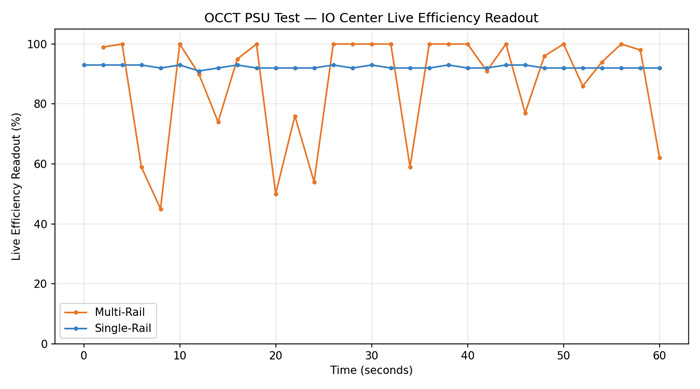
For testing the IO Central features, we did run two one minute runs with OCCT Power (PSU) test, that stretches both the CPU and GPU, putting the highest possible stretch (at least with our system), for the Dark Power 14 IO. All readings were recorded and processed every two seconds to grab display data, plot them and draw conclusions.
Power draw tracks the test pattern, not the rail mode. OCCT's PSU test cycles load in roughly 8–10 second sweeps between ~400–500W and ~850–940W, and both runs reproduce that same sawtooth shape almost in lock-step — confirming that switching rail mode changes how the load is reported and distributed internally, not how much total power the PSU is asked to deliver. Peak draw in both runs approached 930–941W (~72% load), with troughs down around 400–500W (~31–38% load).
The efficiency readout is where the two modes diverge sharply. In Single-Rail mode, IO Center's live efficiency figure was remarkably stable — averaging 92.3% with a standard deviation of just 0.5 percentage points across all 31 samples, never straying outside a 91–93% band despite the load swinging by 500W underneath it. In Multi-Rail mode, the same metric was wildly erratic — averaging 86.8% but ranging from a low of 45.0% up to a pegged 100.0%, with a standard deviation of nearly 18 points. The dips consistently line up with the moments OCCT's load sweep shifts weight between individual 12V rails (e.g., 12V2 vs. 12V5 in our earlier rail-overview screenshot).
We put this behavior to be quiet! directly, and the explanation is straightforward:
In multi-rail mode the output sum is built from 12 values (V and I for each of 12V1–12V6, plus V and I for 3.3V and 5V) that are sampled at slightly different moments, while input power is yet another independently timed value. Under a rapidly changing load like the OCCT PSU test, these cached values go momentarily out of sync, so the ratio transiently under- or overshoots — the dips to 45–60% are that artifact, and anything above 100% is clamped to exactly 100%, which is why the plateaus sit at 100. In single-rail mode there is only one 12V sensor pair, so input and output move together and the readout stays stable. With load split across to individually-measured rails instead of one, each rail's small individual rounding error compounds into a much noisier input/output ratio at the moment OCCT's sweep shifts weight between them — which is exactly the pattern we saw. It's a measurement-precision artifact of how Multi-Rail mode aggregates several smaller readings rather than a flaw in the PSU's actual conversion efficiency, which the Cybenetics lab figures already on this page were measured with proper load-bank equipment, not IO Center's live dashboard.
Practical takeaway. If you're using IO Center's live efficiency readout to sanity-check the PSU under load, Single-Rail mode gives you a steadier number to watch; treat the Multi-Rail figure as noisier by design rather than wrong, especially under load patterns that shift weight between rails quickly.
Independent Lab Verification: Cybenetics Test Report
Beyond be quiet!'s own datasheets, the 1300W unit has an independent certification report from Cybenetics (Lab ID BQ13003313, report issued June 17, 2026), which tears the unit down and runs it through over 1,450 load combinations. This is where the story gets more interesting — and more honest — than the marketing sheet alone.
Who actually builds it. The Dark Power Pro 14 IO 1300W is OEM-manufactured by CWT, using an interleaved PFC, full-bridge LLC primary with synchronous rectification on the secondary — a well-regarded, high-end platform. Key parts include Toshiba APFC MOSFETs, Onsemi NTMFS5C612N MOSFETs on the +12V secondary, and a mix of Nippon Chemi-Con/Rubycon electrolytics plus Nichicon and Nippon Chemi-Con polymer caps for filtering. Actual measured weight is 2.67 kg (5.89 lb).
Real efficiency curve (230V, full range). Cybenetics' lab-measured efficiency across the entire load range slightly exceeds be quiet!'s own published 4-point curve at several points:
| Load | 10% | 20% | 30% | 40% | 50% | 60% | 70% | 80% | 90% | 100% | 110% |
|---|---|---|---|---|---|---|---|---|---|---|---|
| Efficiency | 91.48% | 94.18% | 94.61% | 94.97% | 94.81% | 94.66% | 94.27% | 94.04% | 93.81% | 93.46% | 93.19% |
Peak measured efficiency is actually at 40% load (94.97%), essentially matching be quiet!'s "up to 94.9%" claim — and the unit sustains over 93% efficiency even pushed to 110% load, which speaks well of the ATX 3.1 power excursion handling.
The noise story is more complicated than the datasheet suggests. This is the most important finding from the independent report. Cybenetics' lab-measured noise at 230V under its standard test curve:
| Load | 10–50% | 60% | 70% | 80% | 90% | 100% | 110% |
|---|---|---|---|---|---|---|---|
| Fan speed | 0 RPM | 509 RPM | 743 RPM | 861 RPM | 1030 RPM | 1322 RPM | 1280 RPM |
| Noise | <6.0 dB(A) | <6.0 dB(A) | 12.7 dB(A) | 18.6 dB(A) | 22.6 dB(A) | 30.7 dB(A) | 28.7 dB(A) |
Two things worth flagging: first, the fan genuinely stays off up through 50% load in Cybenetics' testing, which is excellent and matches be quiet!'s semi-passive claims. Second, at 100% load the independently measured 30.7 dB(A) is notably higher than the 22.1–22.2 dB(A) be quiet! publishes in its own Active/Semi-Passive mode datasheet tables. The discrepancy is likely explained by differences in fan curve/mode configuration and test methodology between be quiet!'s in-house measurement and Cybenetics' automated load-bank sweep — but it's a meaningful enough gap that buyers planning to run this PSU consistently near its full 1300W ceiling shouldn't assume it'll be as whisper-quiet at 100% load as the datasheet implies. Below ~80% load, real-world noise stays very low either way.
Ripple, regulation, and protection all check out cleanly. Full-load 12V ripple measured 37.45mV (well inside the 120mV ATX limit), with 5V/3.3V/5VSB ripple all in the 25–30mV range — genuinely clean output consistent with the digital full-bridge LLC topology. Load regulation stayed tight across all rails (0.24–0.97%). OCP tripped at 131.4–131.8A on the 12V rail (about 121% of rated), and OPP tripped between 117.7% and 123.5% of rated power depending on temperature — both comfortably inside safe ATX 3.1 excursion behavior. Hold-up time measured 26.8ms, clearing the ATX minimum with room to spare. One notable gap: Cybenetics lists Fan Failure Protection as not present on this unit, unlike some competitors that will shut down or alert if the fan itself dies.
Who It's For
This is not a budget or even a "mainstream enthusiast" PSU — 1300W of Titanium-rated headroom is overkill for the vast majority of single-GPU systems. It makes the most sense for:
- Overclockers who want single-rail flexibility without giving up multi-rail safety day-to-day
- Builders running the most power-hungry current or next-gen GPUs who want serious headroom and native 12V-2x6 support
- Anyone who wants to actually see what their PSU is doing in real time rather than trusting a black box
- Silence-focused builds where even 100% load noise needs to stay low
If your build draws well under 700–800W at the wall, the extra headroom of the 1300W (let alone the 1600W) is mostly future-proofing and peace of mind rather than a practical necessity — but that headroom is exactly what keeps efficiency and noise low at your system's actual operating point, since a PSU running at 30% of its capacity is quieter and more efficient than one running near its limit.
Conslusions
The be quiet! Dark Power Pro 14 IO, is less about a raw power increase and more about be quiet! finally giving Dark Power Pro owners the kind of granular software control that AIO coolers and RGB ecosystems have had for years. Titanium efficiency, genuinely low noise figures even under load, a 10-year warranty, and full ATX 3.1/PCIe 5.1 readiness make the fundamentals excellent — the IO Center software is simply the layer that makes those fundamentals easier to see and tune.
The 1300W's ATX 3.1 credentials and 800W combined 12V-2x6 headroom comfortably cover every current-generation GPU on the market, including cards that draw 600W at stock with brief spikes well beyond that — the whole point of the ATX 3.1 excursion-handling requirements this unit is built to. It's not a stretch pick even for a single flagship-tier card paired with a heavily overclocked CPU; where you'd want to step up to the 1600W instead is a dual-GPU workstation or an extreme-overclocking rig that will genuinely pull close to four figures at the wall.
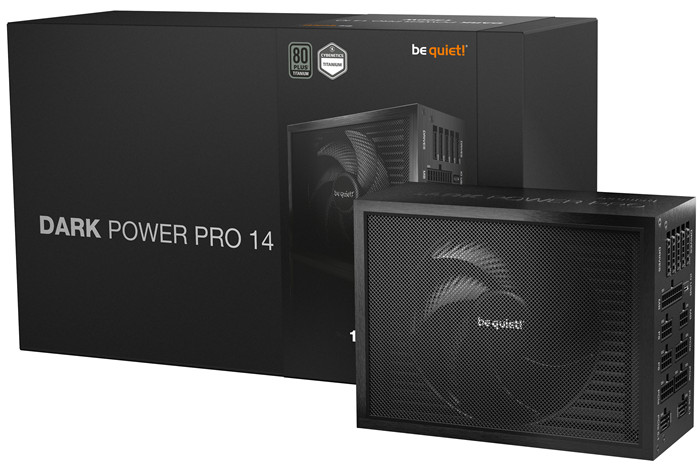
The product supports the latest ATX standard especially the ATX 3.1 that has a re-design of the 12VHPWR connector for NVIDIA graphic cards since all AMD cards are still using the PCI-e 6+2-pin connector. The retail price of the 1300Watt model is around $479.90 / €439.90 / £ 399.99, which is at the top high-end-priced power supplies of the market. The product also supports 10 years of warranty making it appealing for overclockers, & enthusiasts who wish only the best for their system. We do feel that be quiet! will support-push even more the IO Control functions with new versions giving users useful data about the performance of their systems and overall power consumption.

Safety and Warranty
The full standard suite is present: OCP, OVP, UVP, SCP, OPP, and OTP protection. Backing it all up is a 10-year manufacturer's warranty, which remains one of the strongest guarantees in the PSU market and reflects real confidence in the component quality (Japanese 105°C caps, in particular).Pricing and Availability
| Region | MSRP |
|---|---|
| EU | €439.90 |
| UK | £399.99 |
| US | $479.90 |
Market availability is set for September 1, 2026. At this price point, the 1300W IO competes with other Titanium-rated 1200–1300W units from Seasonic, Corsair, and FSP, and its positioning above those is almost entirely the IO Center software layer plus the single-sleeve cabling and aluminum chassis. See the comparison section below for how it stacks up against its own 1600W sibling.
1300W vs. 1600W: Which One Should You Buy?
The two Dark Power Pro 14 IO models are built on the same platform — same aluminum chassis, same digital full-bridge LLC topology, same IO Center software, same 10-year warranty, same 200×150×86mm footprint. The differences are entirely about how much power they deliver and, in a couple of areas, exactly how they deliver it.
| Spec | 1300W | 1600W |
|---|---|---|
| Article No. (EU) | BP022EU | BP023EU |
| Certification | 80 PLUS Titanium / Cybenetics Titanium | 80 PLUS Titanium / Cybenetics Titanium |
| Efficiency @ 230V, 10/20/50/100% | 91.9 / 94.6 / 94.9 / 93.9% | 91.7 / 94.2 / 94.9 / 93.4% |
| Noise, Active mode (10/20/50/100% load) | 8.7 / 8.8 / 9.2 / 22.2 dB(A) | 9.4 / 9.5 / 9.8 / 29.1 dB(A) |
| Noise, Semi-Passive mode (10/20/50/100% load) | 8.5 / 8.6 / 8.7 / 22.1 dB(A) | 9.0 / 9.2 / 9.4 / 29.1 dB(A) |
| 12V rails (Multi mode) | 6 | 6 |
| 12V1–12V4 max current | 35A / 35A / 40A / 40A | 40A / 40A / 45A / 45A |
| 12V5–12V6 max current | 55A / 55A | 55A / 55A |
| Max. combined power 12V (W) | 1300 W | 1600 W |
| 12V-2x6 combined power (2 connectors, Single-rail) | 1200W | 1200W |
| PCIe 6+2-pin connectors | 6 | 6 |
| SATA / Molex connectors | 16 / 5 | 16 / 5 |
| MSRP (EU / UK / US) | €439.90 / £399.99 / $479.90 | €479.90 / £449.99 / $499.90 |
A few things stand out from that table:
- Efficiency is essentially a wash. Both units peak at 94.9% at 50% load, and the 1300W is actually a hair more efficient at every other load point — not because it's a "better" unit, but because a given wattage load represents a larger percentage of the 1300W's capacity, which tends to land it closer to the efficiency curve's sweet spot for typical gaming loads.
- Noise is where the gap really opens up. At 100% load, the 1300W tops out at 22.1–22.2 dB(A) while the 1600W climbs to 29.1 dB(A) in both fan modes — a meaningfully audible difference. This makes sense: pushing 1600W through the same-size heat sink and fan generates more heat that needs moving, so the fan has to work harder at full tilt. If you're never going to load a PSU anywhere near 1600W anyway, the 1300W will run quieter under real-world stress simply by virtue of operating at a lower percentage of its ceiling.
- The 12V-2x6 headroom is the real differentiator for future-proofing. The 1600W's 1000W combined rating across its two native GPU power connectors gives it genuine dual-flagship-GPU or extreme-overclock headroom that the 1300W's 800W doesn't quite match. If you're planning a build around the most extreme current or next-gen GPU (or more than one), that extra 200W of connector headroom is the 1600W's strongest argument.
- Everything else is identical. Connector counts (PCIe, SATA, Molex), cable composition, IO Center feature set, warranty terms, and build materials don't change between the two — you're not sacrificing anything except raw wattage and connector headroom by going with the 1300W.
Bottom line: for the vast majority of single-GPU builds — even ones running a flagship current-gen card and an overclocked CPU — the 1300W hits the better price-to-performance-to-noise balance. Step up to the 1600W only if you're specifically planning a dual-GPU workstation, an extreme overclocking rig that will actually draw near four figures at the wall, or you simply want the extra 12V-2x6 headroom as insurance for whatever GPU comes next.