Breaking News

Sony Announces the Launch of Xperia 1 VIII Kioxia Unveils High Performance KIOXIA XG10 Series SSDs for PC OEMs AMD Expands AMD Ryzen PRO 9000 Series Processor Lineup Thypoch enters autofocus market with Voyager 24-50mm f/2.8 for Sony E-mount PlayStation Plus Game Catalog for May 2026

logo

  • Share Us
    • Facebook
    • Twitter
  • Home
  • Home
  • News
  • Reviews
  • Essays
  • Forum
  • Legacy
  • About
    • Submit News

    • Contact Us
    • Privacy

    • Promotion
    • Advertise

    • RSS Feed
    • Site Map

Search form

Imec and NUS to Collaborate on Chip-based Quantum Cryptography

Imec and NUS to Collaborate on Chip-based Quantum Cryptography

Enterprise & IT Sep 13,2019 0

Research hub in nanoelectronics and digital technologies Imec and the National University of Singapore (NUS) signed a research collaboration agreement to develop chip-based prototypes for secure quantum communication networks.

In the frame of this five-year agreement, imec and NUS plan to will jointly develop "scalable and efficient technologies" for quantum key distribution and quantum random number generation, which are amongst the basic building blocks of a truly secure Quantum Internet.

Research in quantum information science has indicated that large-scale quantum computers (when realized) will render most of today’s encryption techniques insecure. Although one might argue that such a large-scale quantum computer is still some time away, the situation is nevertheless an urgent one. To that end, two broad directions have been pursued globally, namely a software-based approach called post-quantum cryptography and a hardware-based approach called quantum cryptography.

Post-quantum cryptography is essentially about updating existing cryptographic algorithms and standards so that current infrastructures would be ready for a post-quantum digital world. It however maintains a security profile that is still based on unproven assumptions. Quantum cryptography, on the other hand, offers a much stronger security guarantee: its security is solely based on the laws of quantum physics and thus is in principle unbreakable.

Hence, with regards to critical information infrastructures with long-term security needs such as healthcare, government and banking, quantum cryptography is the safer way to go. With this approach, two essential building blocks are quantum key distribution (QKD) and quantum random number generation (QRNG). At present, however, the methods and processes enabling these quantum technologies are limiting and expensive. Consequently, these bottlenecks have made quantum cryptography unattractive for wide-spread deployment.

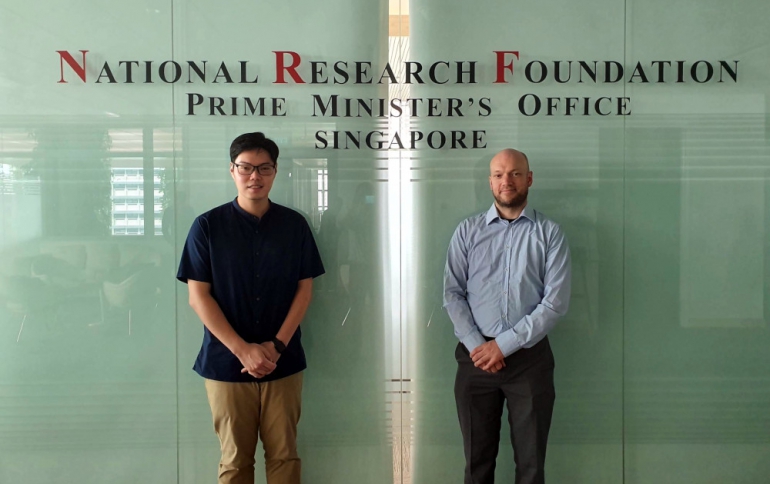
Together, imec and NUS aim to resolve some of these bottlenecks. The overarching objective is to move QKD and QRNG technologies to a platform which is much more scalable, robust, and cost-effective. The research collaboration is supported by the National Research Foundation Singapore under the Quantum Engineering Programme.

“Our approach consists of developing and integrating all QKD key components in a single silicon-photonics based chip, which ensures a cost-effective solution,” says Joris Van Campenhout, R&D Program director at imec. “As a first deliverable, we will jointly develop an ultrafast quantum random number generation (QRNG) chip, a key component for generating the secret keys. Secondly, we will work on a compact, fully-integrated photonic quantum transmitter prototype chip. In these efforts, we will strongly leverage imec’s deep expertise in silicon photonics technology, originally developed for conventional datacom and telecom applications.”

Tags: Quantum computingimeccryptography
Previous Post
Updated Google Photos Let You Relive Your Memories
Next Post
House Panel Looking For Tech Company Records in Antitrust Investigation

Related Posts

  • IBM Expands the Computational Power of its IBM Cloud-Accessible Quantum Computers

  • Imec Uses Machine Learning Algorithms in Chip Design to Achieve cm Accuracy and Low-power Ultra Wideband Localization

  • UK Companies to Build Operating System for Quantum Computers

  • Intel and QuTech Demonstrate High-Fidelity ‘Hot’ Qubits for Practical Quantum Systems

  • D-Wave Provides Free Quantum Cloud Access for Global Response to COVID-19

  • IBM Shows How Archimedes Could Estimate Pi Using a Quantum Computer

  • Infineon, Cypress Deal Wins CFIUS Clearance

  • Honeywell to Develop The World’s Most Powerful Quantum Computer

Latest News

Sony Announces the Launch of Xperia 1 VIII
Smartphones

Sony Announces the Launch of Xperia 1 VIII

Kioxia Unveils High Performance KIOXIA XG10 Series SSDs for PC OEMs
Enterprise & IT

Kioxia Unveils High Performance KIOXIA XG10 Series SSDs for PC OEMs

AMD Expands AMD Ryzen PRO 9000 Series Processor Lineup
PC components

AMD Expands AMD Ryzen PRO 9000 Series Processor Lineup

Thypoch enters autofocus market with Voyager 24-50mm f/2.8 for Sony E-mount
Cameras

Thypoch enters autofocus market with Voyager 24-50mm f/2.8 for Sony E-mount

PlayStation Plus Game Catalog for May 2026
Gaming

PlayStation Plus Game Catalog for May 2026

Popular Reviews

Akaso 360 Action camera

Akaso 360 Action camera

Dragon Touch Digital Calendar

Dragon Touch Digital Calendar

be quiet! Pure Loop 3 280mm

be quiet! Pure Loop 3 280mm

Noctua NF-A12x25 G2 fans

Noctua NF-A12x25 G2 fans

Soft2bet and the unseen hardware that makes instant play possible

Soft2bet and the unseen hardware that makes instant play possible

Crucial T710 2TB NVME SSD

Crucial T710 2TB NVME SSD

JSAUX 65Wh Rog Ally Battery

JSAUX 65Wh Rog Ally Battery

Endorfy Thock V2 Wireless Keyboard

Endorfy Thock V2 Wireless Keyboard

Main menu

  • Home
  • News
  • Reviews
  • Essays
  • Forum
  • Legacy
  • About
    • Submit News

    • Contact Us
    • Privacy

    • Promotion
    • Advertise

    • RSS Feed
    • Site Map
  • About
  • Privacy
  • Contact Us
  • Promotional Opportunities @ CdrInfo.com
  • Advertise on out site
  • Submit your News to our site
  • RSS Feed