Arctic MX-7
1. Introduction
Thermal paste is one of those components that rarely receives the same attention as CPUs, GPUs, or cooling hardware, yet it plays a critical role in determining how effectively heat is transferred from a processor to its cooler. A poor thermal interface can easily negate the benefits of a premium heatsink or AIO, while a well-engineered compound can reduce temperatures, improve sustained boost clocks, and maintain performance over years of operation.
Arctic has long been one of the most respected names in thermal interface materials. Since the introduction of the MX-2 in 2007, the company's MX series has become a staple recommendation for enthusiasts, system builders, and overclockers alike. Each generation has focused on incremental improvements rather than radical redesigns, emphasizing reliability and consistency over marketing claims.
The MX-7 continues this philosophy. Rather than promising dramatic temperature reductions, Arctic has concentrated on improving thermal conductivity, application consistency, and perhaps most importantly, long-term durability under repeated thermal cycling.
The question is simple: does the MX-7 justify replacing one of the best thermal pastes already on the market?
After examining its formulation, application characteristics, and cooling performance, the answer is largely yes.
Packaging & Presentation
The MX-7 is supplied in Arctic's familiar syringe packaging, available in multiple capacities to suit everyone from individual PC builders to professional system integrators. The 2gr sample we got has width: 21 mm, Height: 13 mm, Length: 95 mm and Weight: 0.01 kg.
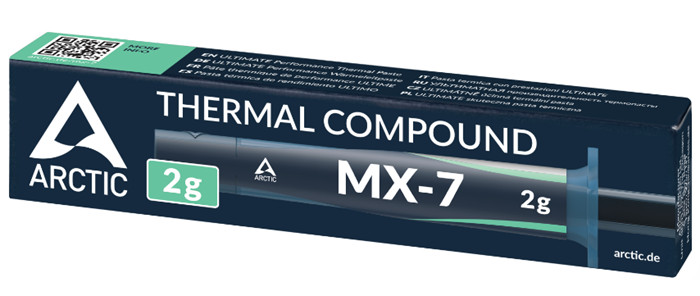
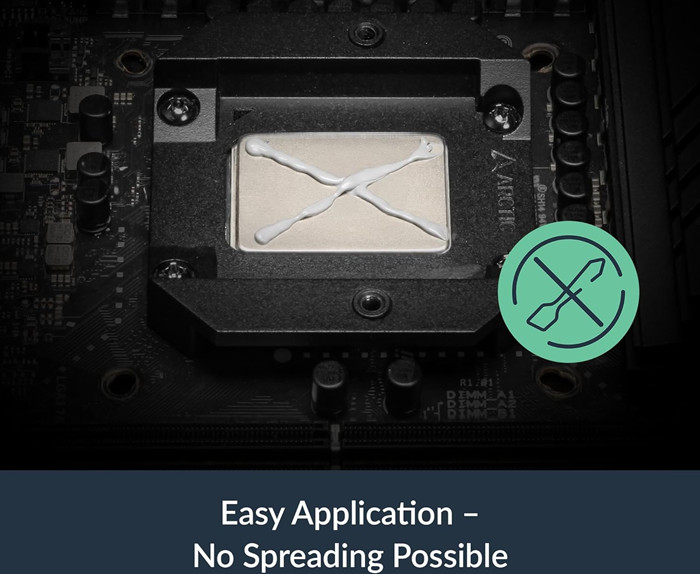
Included with larger tubes are disposable application spatulas, although Arctic explicitly recommends allowing mounting pressure to distribute the compound naturally instead of manually spreading it.
The syringe itself feels well engineered, with a smooth plunger that provides consistent pressure throughout application.
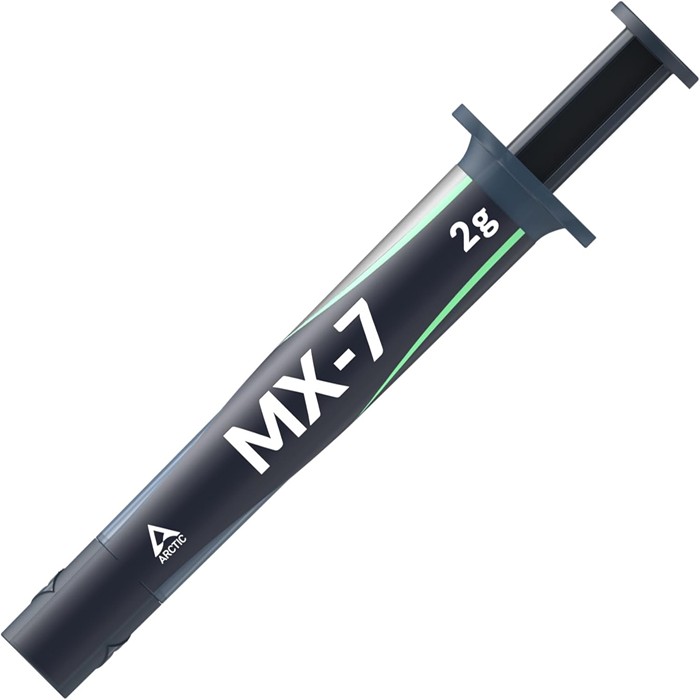
Unlike some thicker premium compounds, the MX-7 does not exhibit noticeable oil separation even after storage, suggesting good stability of the suspension medium. This may sound insignificant, but inconsistent paste separation has historically been an issue with some high-performance compounds.
Composition & Engineering
Unlike liquid metal compounds that rely on gallium alloys, Arctic continues using a carbon-based, electrically non-conductive formulation. Arctic's own Safety Data Sheet confirms the exact recipe: 88.4% aluminum, 11.5% polydimethylsiloxane, and 0.1% melanins by weight, with a measured viscosity of 37,400 poise, squarely in the middle of Arctic's stated 35,000–38,000 poise range.
This immediately gives the MX-7 several advantages:
- Zero electrical conductivity
- No risk of short circuits
- No corrosion of copper or nickel-plated surfaces
- Compatibility with aluminum heatsinks
- Safe use around exposed motherboard components
The compound itself is noticeably denser than previous Arctic formulations.
Arctic's own spec sheet backs this up with hard numbers. MX-7 is rated for a continuous use temperature range of -50°C to 250°C, has a density of 2.9 g/cm³, a volume resistivity of 1.7 × 10¹² Ω·cm, and a breakdown voltage of 4.2 kV/mm, figures that put real weight behind the "non-conductive" marketing claim rather than leaving it as a vague promise.
One notably absent figure: thermal conductivity. This isn't an oversight. Arctic has stated publicly that it deliberately declines to publish a W/mK number for any of its pastes, arguing that real thermal paste sits in the 1–4 W/mK range and that competitors quoting figures like 12.5 W/mK are simply not telling the truth. Whether or not you agree with the marketing strategy, it's a refreshingly blunt stance in an industry known for inflated spec sheets.
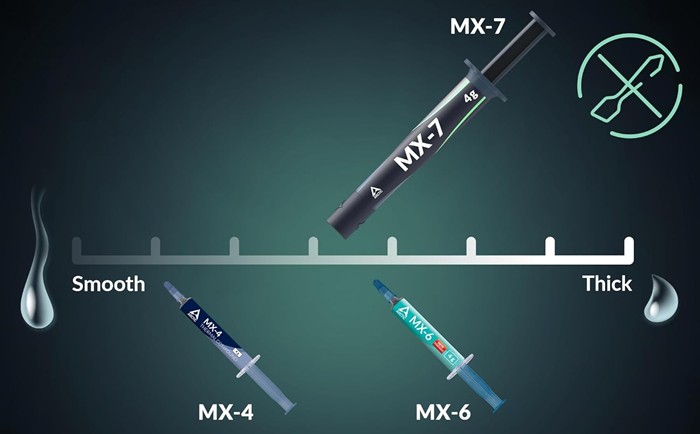
This isn't simply a change in feel—it reflects Arctic's focus on reducing one of the biggest long-term problems affecting thermal interface materials: pump-out. Pump-out occurs when repeated expansion and contraction of the CPU package gradually forces thermal compound away from the center of the integrated heat spreader. Over time this creates microscopic air gaps that increase thermal resistance. By increasing cohesion within the paste, Arctic aims to keep the compound in place for significantly longer service intervals. For desktop systems this may represent a modest benefit. For laptops, GPUs, and high-power CPUs experiencing constant thermal cycling, it could substantially extend the useful life of the application.
Safety & Regulatory Notes
Arctic's Safety Data Sheet backs up the "safe to handle" claims with real regulatory detail. MX-7 isn't classified as hazardous under EU CLP regulation, so it carries no hazard pictograms, no signal word, and no hazard statements. It's non-flammable, non-explosive, and has a flash point above 200°C. On skin, the SDS notes it generally doesn't cause irritation, and it's odorless. For shipping, it doesn't qualify as dangerous goods under ADR, IMDG, or IATA rules, so there's no special handling required to ship or receive it.
One mildly interesting wrinkle: because the paste is 88.4% aluminum, that ingredient carries a workplace exposure limit for inhalable aluminum dust in places like Germany, France, and Ireland, standard practice for handling bulk aluminum-based powders in a factory setting, not something that affects a PC builder squeezing a syringe. Arctic also notes that despite the product itself being low-hazard, it shouldn't be tossed in with household garbage or allowed to reach the sewer system; empty tubes should be disposed of according to local regulations rather than just thrown in the trash.
Installation Experience
Application characteristics are where users will notice the largest difference from previous MX compounds. The MX-7 is considerably thicker than the older MX-4 and somewhat firmer than the MX-6. Builders accustomed to manually spreading thermal paste may initially find it resistant.
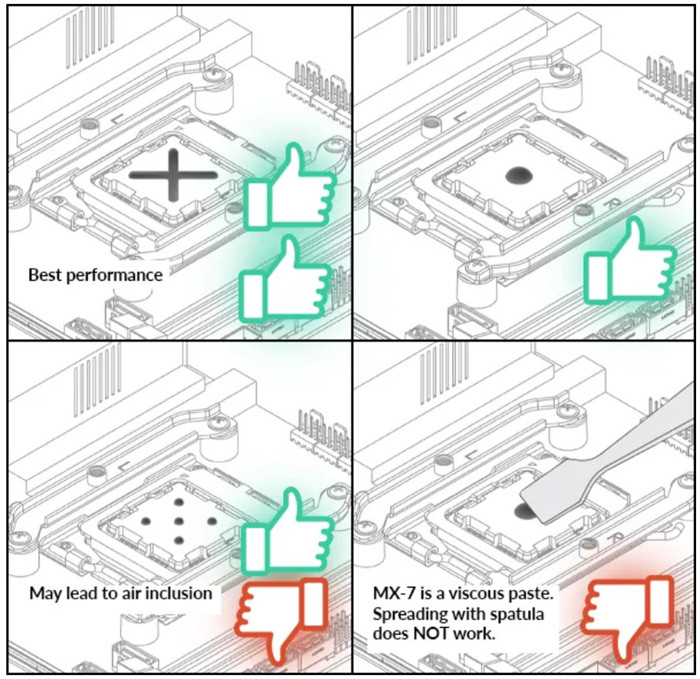
Fortunately, this isn't how Arctic intends the product to be used. Instead, the recommended X-pattern or central application allows cooler mounting pressure to distribute the compound evenly across the heat spreader. Under sufficient mounting pressure, the paste spreads remarkably uniformly with little evidence of trapped air pockets. Cleanup is equally straightforward. Because the paste remains non-curing and non-conductive, excess material can be removed with isopropyl alcohol without leaving hardened residue behind.
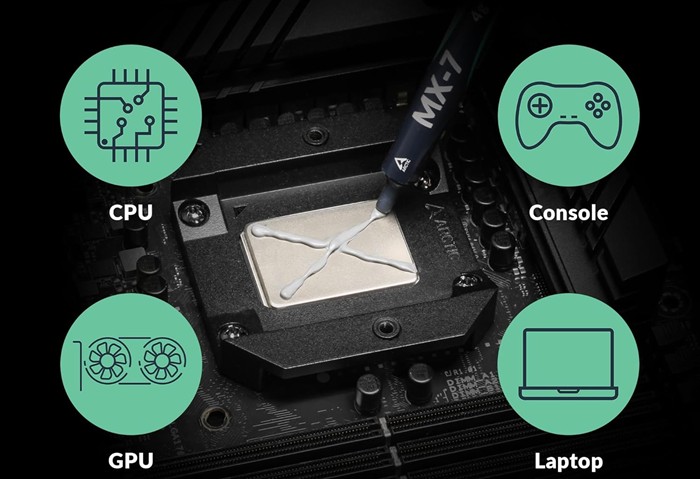
Arctic's own application guidance offers a couple of practical tips worth passing along: tilt the syringe after dispensing enough paste to avoid stringing, and if too much comes out, simply wipe it off, since the non-conductive formula means excess paste can't cause a short circuit. Arctic also specifically recommends the cross pattern even for coolers with direct-touch heat pipes, noting that it more reliably fills the small grooves between pipes than a central dot alone.