Sandisk Rolls Out a Trio of AI-Storage Announcements Ahead of FMS 2026
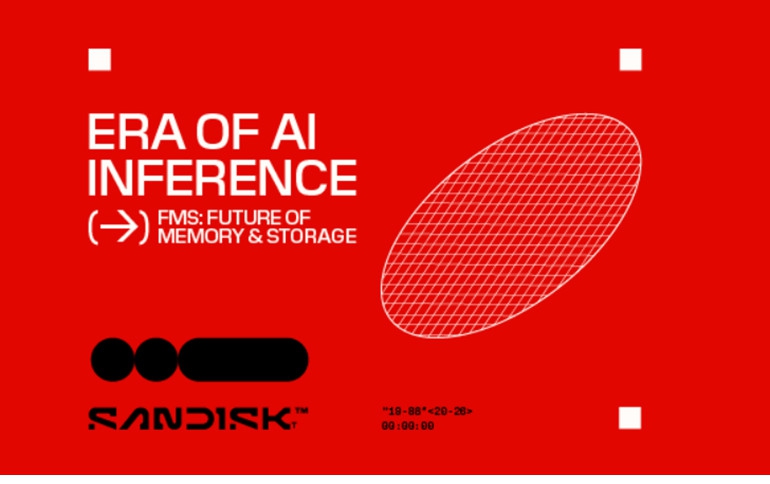
Sandisk entered this week's Future of Memory and Storage Conference (FMS 2026) with a coordinated set of announcements spanning industry standardization, next-generation NAND technology, and a broader showcase of its AI-infrastructure roadmap.
A New Standard for High Bandwidth Flash
On August 3, Sandisk and SK hynix announced they had published the first technical specification for HBF (High Bandwidth Flash) through the Open Compute Project (OCP) — just six months after the HBF workstream was formed within the consortium. The spec was developed with Sandisk and SK hynix as lead contributors, and Google and Tenstorrent later joined as members, helping validate the technology and shape the standard.
The document lays out system interface, electrical, and packaging guidelines for HBF, including the host interface between AI accelerators and HBF stacks, reliability requirements, and software guidance for read/write operations. The goal is to give AI system designers a common framework for building high-capacity, high-bandwidth memory that can sit close to compute — and to let HBF coexist architecturally with High Bandwidth Memory (HBM).
Sandisk CTO Alper Ilkbahar said AI inference is creating a new set of memory requirements that HBF technology is designed to meet, calling the specification a milestone for building AI systems meant to improve the economics of running large models at scale.
sandisk
A Denser QLC NAND Generation
A day later, Sandisk and Kioxia unveiled their 10th-generation QLC 3D flash memory, built on the companies' CMOS-directly-Bonded-to-Array (CBA) process, which manufactures logic and memory-array wafers separately before precision-bonding them together. The companies say the new generation delivers up to a 60% increase in bit density over their 8th-generation NAND, surpassing 37 Gb/mm² — which they're calling an industry benchmark for density, performance, and power efficiency.
Key technical highlights include:
A 332-layer architecture with an optimized floorplan for the density gains
A 4.8 Gb/s NAND interface — a first for QLC 3D flash — enabled by Toggle DDR6.0 and a Separate Command Address protocol
Power-Isolated Low-Tapped Termination (PI-LTT) to improve I/O power efficiency during data transfer
Kioxia CTO Hideshi Miyajima noted that as AI use cases expand from generative to agentic and physical AI, QLC technology helps handle the resulting growth in data volumes efficiently, and said Kioxia will push toward commercializing this 10th-generation flash. Ilkbahar added that the new NAND generation is meant to establish a new density-bandwidth-efficiency baseline for high-capacity flash storage supporting next-generation infrastructure.
Bringing It Together at FMS 2026
Rounding out the week, Sandisk detailed its full presence at FMS 2026 (Booth #607, Santa Clara Convention Center), framing both announcements within a broader pitch: that memory and storage, not just compute, are now central bottlenecks in scaling AI inference. Chief Product Officer Khurram Ismail said data movement and access efficiency have become as important as compute itself as inference workloads grow, and pointed to Sandisk's ongoing work on next-generation NAND and HBF to help address that.
Sandisk's FMS booth and sessions will spotlight:
BiCS10 QLC NAND — the newly announced 10th-generation flash
AI Data Cycle framework — Sandisk's updated model for mapping storage needs across the AI lifecycle, from raw data lakes through training, inference, and generated-content storage
HBF technology — the newly standardized near-compute memory architecture
Enterprise SSDs — high-endurance designs for KV cache workloads, upcoming PCIe Gen 6 support, and ultra-high-capacity E3.S drives with reduced DRAM
The company's keynote, "NAND: The Versatile & Scalable Foundation of the AI Era," is scheduled for Wednesday, August 5 at 11:40 a.m. PT in the Mission City Ballroom, featuring CRO Jim Elliott, CPO Khurram Ismail, and CTO Alper Ilkbahar. A follow-up panel, "Breaking the Memory Wall with High Bandwidth Flash," featuring Sandisk, SK hynix, and Google, takes place Thursday, August 6 at 9:45 a.m. PT in Ballroom D, moderated by Thomas Coughlin of Coughlin Associates.
Together, the three announcements position Sandisk's FMS 2026 push around a single narrative: that AI inference workloads — driven by larger models, longer context windows, and agentic applications — are pushing memory and storage architecture into the spotlight alongside raw compute.
more information at
https://www.sandisk.com/company/newsroom/press-releases/2026/2026-08-03-...
https://www.sandisk.com/company/newsroom/press-releases/2026/2026-08-04-...
https://www.sandisk.com/company/newsroom/press-releases/2026/sandisk-nan...