Why Low-Latency Infrastructure Matters More Than Raw Specs
Many serious gamers feel that raw specs are an important factor in their gaming setup but even with advanced CPU and RAM specs, low-latency will leave a lasting impression. Gamers are now prioritizing how the experience makes them feel when they are playing games, and if there is a high-latency infrastructure, this will be enough to put them off playing.
There has also been a shift in the type of games that have become popular, with live dealer casinos games providing a more social and realistic experience of card games. Latency issues in these types of games have a major impact on enjoyment, so implementing a low-latency infrastructure across all levels is important for delivering a high-quality user experience.
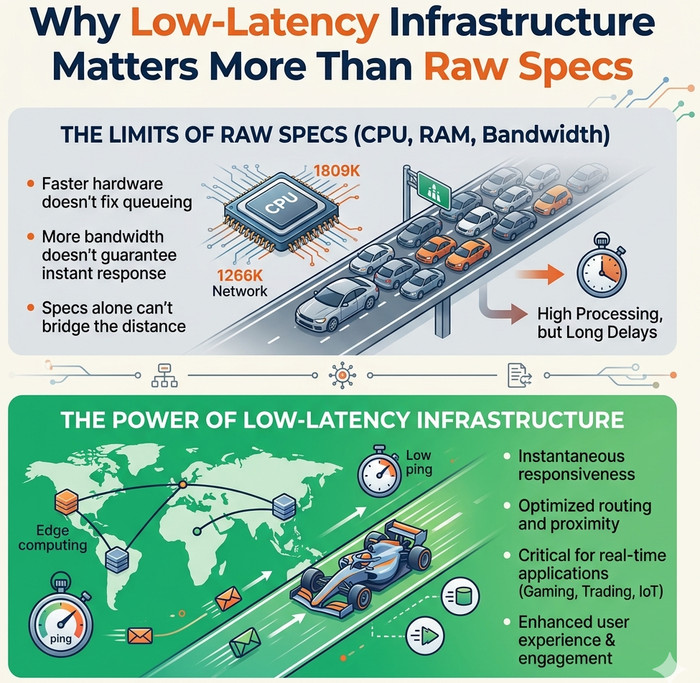
Having fast and stable network connection is essential for low-latency and many game providers have switched to using regional data centers to speed up connection times rather than having longer distances to servers which create higher latency.
These are some of the ways that game providers are developing improved low-latency infrastructures:
Edge Infrastructures
Rather than using one central server, gaming platforms use multiple server locations and route players to their nearest server to prevent latency problems. Even the smallest amount of latency can have a major negative impact on the playing experience, particularly in live dealer games or games with multi-players based in different geographical locations.
Compressing Data and Minimizing Data Transfer
Game providers are getting better at developing games to only send the essential amount of data required, using compress packets to reduce transmission time. This is particularly important with mobile games using mobile data networks that are often slower.
More Frequent Updates
Game developers also prioritize implementing more frequent updates to help fix issues that are causing delays and deliver smoother gameplay. More regular updates mean that players are less likely to encounter stuttering animations with smoother movement and action transitions.
Why These Latency Factors Are More Important Than Raw Specs
When users play video games or casino games on tikalcasino.online, a fast response to actions is important and any delays feel like they have a significant impact on the experience. In fast-paced games, high-latency can affect performance and outcomes, so the games do not feel fair.
High raw specs will not remove lagging if you have a slow connection or if the server is a long distance from the player. Many players would prefer to play games that have a lower standard of graphics if it means that they do not experience latency issues.
Mobile Gaming Is Becoming More Popular
Traditionally, games have predominantly been played using gaming consoles or PCs with high raw specs but more gamers are prioritizing the convenience of mobile games. Therefore, optimized game design features become more important to deliver a smooth gaming experience.
The power behind the device is no longer the key consideration for many gamers, they are more concerned with avoiding lagging. As digital capabilities have improved and fast broadband has become a standard expectation, even minor delays are a bigger frustration for gamers.
More Focus On The Feeling Of The Gaming Experience
A game that lags will feel like it is broken, sending players elsewhere to find a better experience, so developers cannot afford to overlook the importance of low-latency infrastructures.
Not so many years ago, slow loading games were something that gamers were happy to put up with but now the expectations for instant loading are higher. If a player feels frustrated, there are so many other gaming options to explore that they will no longer hang around if they are not getting the experience that they want.
Conclusion: High Quality Raw Specs Are Still Important But Low-Latency Is The Priority
Raw specs are still important in games that have sophisticated graphics and detailed worlds but low-latency has a bigger impact on the user experience. The expectations of smooth, fast gaming have grown and the majority of gamers will now choose games that have low latency.
Best selling games like Fortnite and League of Legends simply don’t require high-spec PCs and accessibility to games from different device types has become a bigger consideration. With mobile gaming now dominating over other devices used to access games, game developers are creating games with low-latency as a focus over advanced graphics and other elements that require high-spec device hardware.
Player retention is largely driven by how smooth a game feels and to ensure a seamless gaming experience, low-latency infrastructures are integral to this. Realistic graphics are no longer the highest priority for a large proportion of gamers, and modern game design reflects this.