China Says Its New Rocket Can Challenge SpaceX
China is reportedly targetting at launching its new space station into orbit later this year, on a commercial-grade rocket that is designed to be more affordable than private rocket launch companies such as SpaceX.
Xinhua News Agency, the official state-run press agency of the People's Republic of China, reported on Monday that the China Manned Space Engineering Office (CMSEO) will send the core module of the now-in-development Chinese Space Station (CSS) to the launch site at Wenchang Space Launch Center in the second half of this year to prepare for the space station missions. The CSS had been expected to launch during 2020.
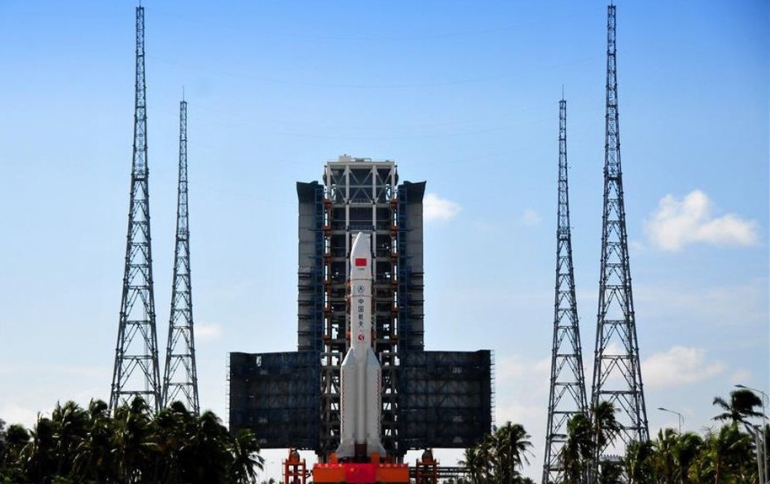
The China Academy of Launch Vehicle Technology (CALVT), on announced that it would test the new Long March-5B heavy-lift rocket in the first half of 2019, making the launch of the CSS later in 2019 much more likely. China's current space station, Tiangong-2 space lab, was launched in 2016 and is due to be de-orbited in the second half of 2019.
Long March-5B is China's most powerful rocket yet, and part of its new 'Dragon Series' of rockets. It is a cariant of the previous Long March 5, which failed in July 2017.
Named Smart Dragon-1 (SD-1), the Chinese Space Station has been designed for launching the four manned spaceflights to enable astronauts to build the CSS. However, China intends to make the Long March-5B rocket available to private companies to launch single or multiple satellites. CALVT claims that the rocket will make it cheaper for companies to send payloads into orbit compared to similar rockets in the international market, such as SpaceX. CALVT also claims that each rocket takes just six months to produce and only 24 hours to prepare for a launch.
According to CALVT, it will now take its first maiden flight in the first half of 2019, which makes it highly possible that it's second or third launch later in 2019 could modules of the CSS into orbit, which would be earlier than expected.
Solar Power Station In Space?
China's ambitions for the space are expandig beyond space stations. The country is planning to build the world's first solar power station in space to provide "inexhaustible clean energy" according to Science and Technology Daily, the official newspaper of China's Ministry of Science and Technology.
The China Academy of Space Technology said that a space solar power system orbiting the Earth at an altitude of 36,000 kilometers could tap the energy of the sun's rays without disruption from atmospheric conditions or loss of sunlight at night. They claim to be already testing the technology and intend to build the station by 2050.
Xie Gengxin, deputy head of the Chongqing Collaborative Innovation Research Institute for Civil-Military Integration in Southwestern China, told the China Daily newspaper that a testing facility in Chongqing's Bishan district is being built that will be used to test the theoretical viability of a space-based solar power station.
The 33 acre test facility will develop space transmission technologies while studying the effect of microwaves beamed back to Earth on living organisms.
"We plan to launch four to six tethered balloons from the testing base and connect them with each other to set up a network at an altitude of around 1,000 meters," said. "These balloons will collect sunlight and convert solar energy to microwave before beaming it back to Earth. Receiving stations on the ground will convert such microwaves to electricity and distribute it to a grid."
Space-based solar power stations would be able to collect sunlight around the clock without being affected by factors such as atmosphere and weather. In addition, the power generated in this manner would be pollution-free and limitless.