Micron M600 SSD Released With Dynamic SLC Cache
Micron today announced a the M600 SATA SSD, based on its 16nm NAND Flash technology and designed to address the storage demands of Ultrabook platforms and tablets, as well as performance-oriented PC desktops. The M600 offers SSD power efficiency as it t draws less than 2 milliwatts (mW) in sleep mode and averages 150mW during active use. Typical laptop hard drives require exponentially more power when idle (130mW) and ten times as much power while they spin their platters to access data during active use (1400mW to 2000mW).
Despite its low power use, the M600 can read data as fast as the SATA interface allows - with random reads up to 100,000 input/output operations per second (IOPS) and 560 MB/s sequential read speeds for all capacities. The M600's write performance is enhanced due to Micron's dynamic write acceleration. The technology switches NAND cells to behave more like higher-grade Flash (from MLC to SLC) on-the-fly, creating a cache that is sized according to drive demands—instead of sacrificing user capacity for a permanent cache.
In traditional NAND caching schemes, the SSD is sometimes designed with a portion of media which is designed for high performance. Generally, this will be a dedicated section of SLC (single level cell) media, used as a cache in front of the main storage array, consisting of MLC (multi-level cell) NAND.
This method works very well in some cases, but has some weaknesses, too. Most evidently, performance problems show up when the SLC cache is full, and the SSD must write new data in the MLC area. This slows performance significantly, and can exhibit itself especially as the SSD becomes full, and is especially evident on smaller capacity drives, such as 128GB and 256GB class SSDs.

Micron’s engineers have come up with a solution: DWA. Micron has the ability to change any given component in an SSD’s NAND array from MLC mode to SLC mode, and back again, at will. Therefore, Micron’s proprietary SSD firmware can accelerate write performance by dynamically adjusting where and how new writes are performed; with no management or manipulation required of the host computer or the end user. In essence, the cache of SLC NAND can change in size and location on the SSD, depending on the nature of the data stream coming to the SSD, and on the current fill state of the SSD.
Micron claims that the end result reduces power use and improves write performance as much as 2.8 times over non-cached systems, ensuring that even the lower-capacity M600 SSDs deliver high write speeds.
This write architecture also helps the M600 achieve greater longevity. For example, the 1TB M600 is warranted to reach up to 400TB total bytes written (TBW), which is five times more than typical client drives. That's enough endurance to write 220GB a day, every day, for five years.
The M600 is also equipped with self-encryption technology designed to meet government standards. The M600's AES-256-bit hardware encryption engine actively encrypts data without performance degradation and complies with the TCG Opal 2.0 standards and the Microsoft eDrive protocol, making it easy to enable using management tools or within Windows 8.v
The drive also features a quality and reliability features including RAIN onboard fail-over protection, client-class power-loss protection for data at rest, and adaptive thermal monitoring, which dynamically adjusts power consumption based on system temperature.
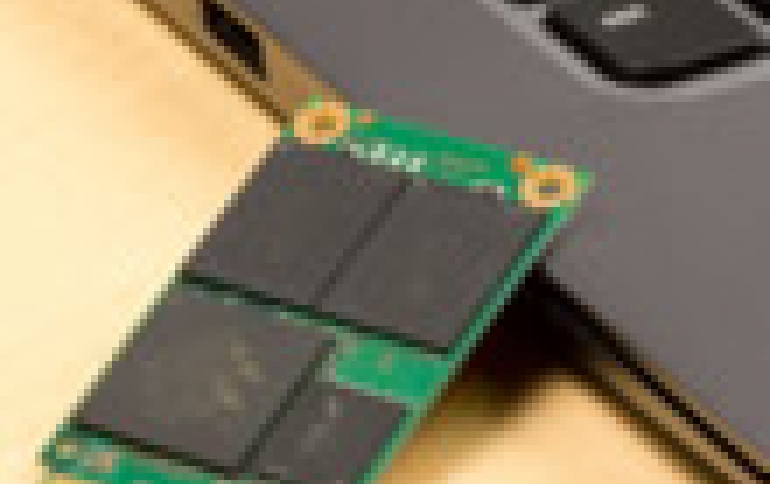
The M600 SSD uses Micron's 128Gb NAND to enable a wide range of capacities in tiny configurations. It is offered in 128 ($80), 256 ($140) and 512GB ($260)mSATA and M.2 module configurations. The gumstick-sized M.2 module is offered in both 80mm and 60mm versions (2280 and 2260) to provide more options for ultra-slim tablet systems. The M600 is also available in a 2.5-inch, 7mm form factor, which is available in capacities from 128GB to 1TB ($450).
The M600 SSD is currently in production and is sold directly to OEMs and to system builders.
2.5-Inch |
mSATA |
M.2 |
|
| Capacity | 128GB, 256GB, 512GB, 1TB | 128GB, 256GB, 512GB | |
| Interface | SATA 6 Gb/s |
||
| Sequential performance (up to) |
Read: 560 MB/s Write: 510 MB/s |
||
| Random performance (up to) | Read: 100,000 IOPS Write: 88,000 IOPS |
||
| PCMark Vantage score (up to) | 87,000 |
||
| Active average power consumption (TYP) |
150mW |
||
| Idle average power consumption |
<100mW |
||
| Device sleep power consumption | <2mW |
||
| Endurance (TBW) | 128GB: 100TB, 256GB: 200TB, 512GB: 300TB, 1TB: 400TB |
||
| Operating temp | 0°C to +70°C |
||
| Dimensions | 2.5-inch: 100.45 x 69.85 x 7mm mSATA: 50.80 x 29.85 x 3.75mm M.2 2280: 80 x 22 x 3.58mm M.2 2260: 60 x 22 x 2.3mm |
||
| Weight (MAX) | 70g |
10g |
|
| MTTF | 1.5 million hours |
||