Kioxia Exceria Plus G3 512GB microSD
2. Tests
For our tests, we used an AMD based system (AMD 7950X), paired with an Asus ProArt X670E motherboard with the latest BIOS and Windows 11 with all the latest driver/updates installed. The microSD has around 461GB real empty space.
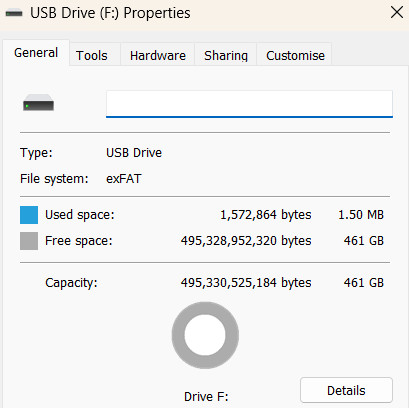
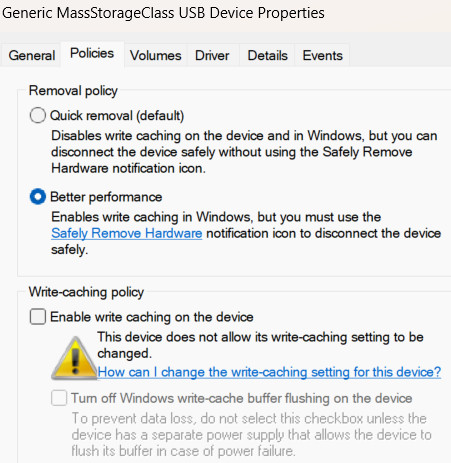
While we enabled the "Better Performance" under the Removal policy (Write-caching is not available)
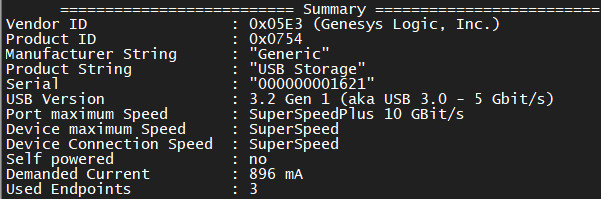
Phase 1: Standard USB Card Reader (Genesys Logic USB 3.2 Gen 1)
Our first test phase used a Genesys Logic USB 3.2 Gen 1 (5 Gbit/s) reader — a generic, widely available reader representative of what the majority of users already own. While the host port is theoretically capable of 5 Gbit/s, the UHS-I card interface caps practical throughput well below that figure.
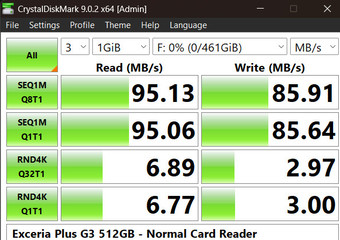
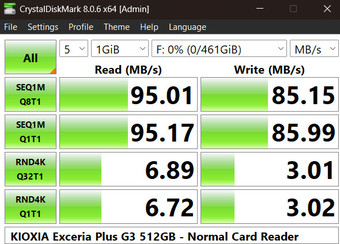
Sequential performance across CrystalDiskMark versions 3.0, 6.0, 7.0, and 9.0 was remarkably consistent. Reads clustered tightly between 94.95 and 95.27 MB/s, while writes landed in the 82.52–86.13 MB/s range. The slight write variance across CDM versions reflects differences in queue depth and test methodology, not real-world instability.
|
|
CDM 9.0 — Genesys Logic Reader |
CDM 8.0 — Genesys Logic Reader |
|
|
CDM 7.0 — Genesys Logic Reader |
CDM 6.0 — Genesys Logic Reader |
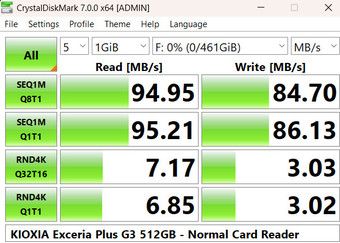
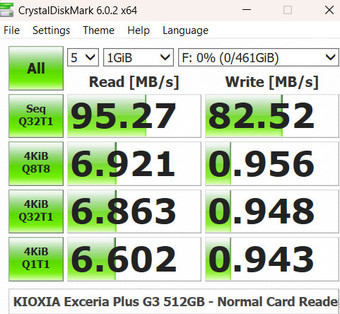
CDM 3.0 results (below) confirm the same sequential ceiling, and additionally include a 512K block size row: 86.85 MB/s read / 43.07 MB/s write — the expected performance drop for sub-1 MB block transfers on NAND flash.
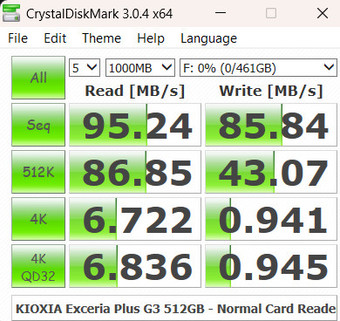
CDM 3.0 — Genesys Logic Reader (512K row unique to this version)
Random 4K reads averaged ~6.8–6.9 MB/s — comfortably meeting the A2 threshold. Random 4K writes diverge between CDM versions: newer versions (7.0, 9.0) report ~3.0 MB/s, while older versions (3.0, 6.0) return ~0.94–0.96 MB/s. This is well-documented behaviour caused by the lower queue depths and less favourable access patterns used in older CDM releases; the modern figures are the relevant benchmark.
The ATTO chart is telling: read performance plateaus at approximately 90–91 MB/s from the 64 KB block size and holds flat through 64 MB. Write performance settles at ~82–83 MB/s from 1 MB upward. These figures confirm the card is saturating the reader, not the other way around — which is exactly what we want to see ahead of the fast-reader test phase.
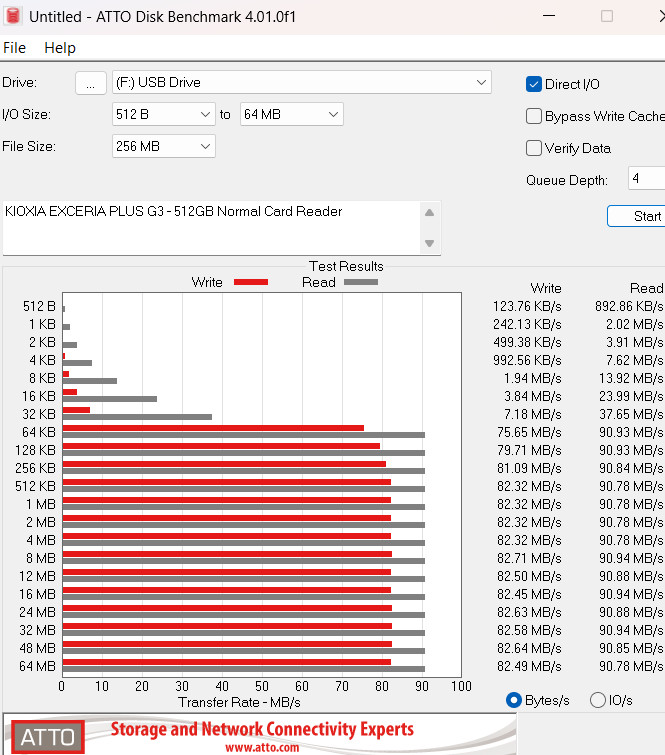
ATTO Disk Benchmark — Genesys Logic Reader | Reads plateau ~90–91 MB/s; Writes plateau ~82–83 MB/s from 1 MB+
Phase 2: High-Performance Reader (UGREEN CM265)
The UGREEN CM265 is a USB 3.2 Gen 2 (10 Gbit/s) card reader designed specifically to remove the reader bottleneck from UHS-I benchmarking.
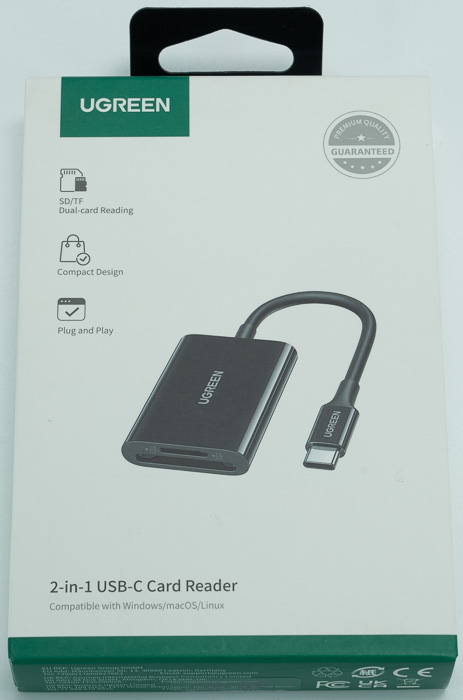
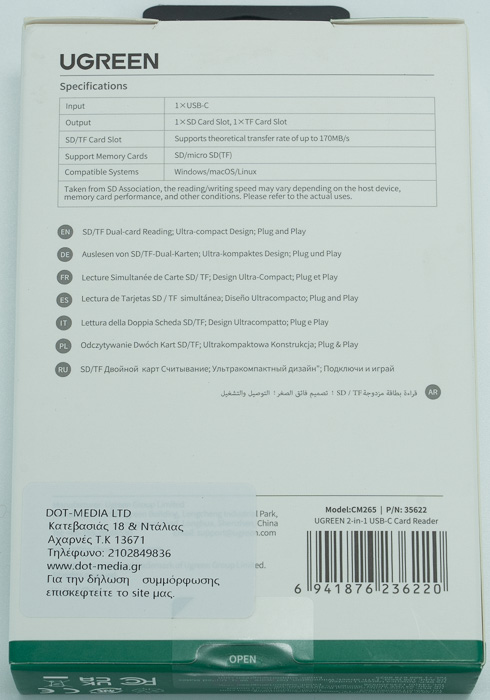
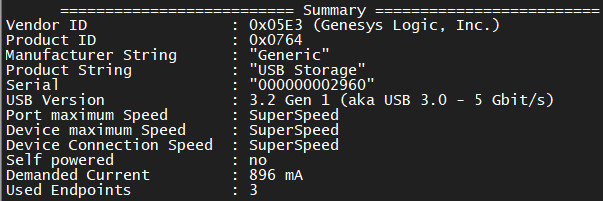
Swapping to the CM265 produced an immediate and dramatic step change in performance across every metric. The UGREEN CM265 again is recognized as 3.2Gen1 (5Gbit/s) and as Generic, hopefully performance would be ideal as KIOXIA mentions.
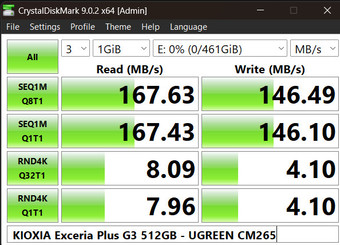
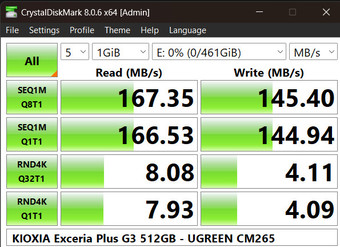
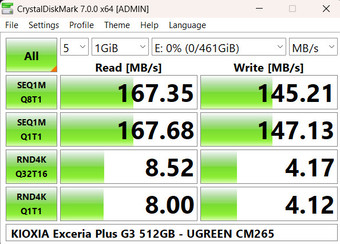
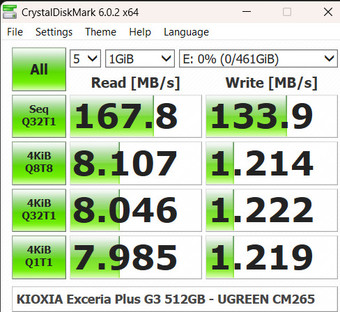
Sequential reads jumped from ~95 MB/s to approximately 167–168 MB/s across all four CDM versions tested — a 76% improvement. Sequential writes climbed from ~85 MB/s to approximately 144–147 MB/s, approaching the card's advertised 150 MB/s specification ceiling. The consistency across CDM 3.0, 6.0, 7.0, and 9.0 is striking: there is virtually no variance in sequential read performance, and write variance remains within a narrow 3 MB/s band.
|
|
CDM 9.0 — UGREEN CM265 |
CDM 8.0 — UGREEN CM265 |
|
|
CDM 7.0 — UGREEN CM265 |
CDM 6.0 — UGREEN CM265 |
CDM 3.0 with the UGREEN CM265 adds further texture: the 512K block test now shows 140.7 MB/s read and 61.74 MB/s write — a significant improvement over the 86.85 / 43.07 MB/s seen on the slow reader, confirming the card genuinely has more to give at intermediate block sizes when the reader stops being the constraint.
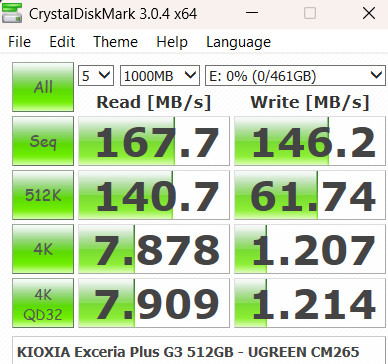
CDM 3.0 — UGREEN CM265 (note improved 512K row: 140.7 / 61.74 MB/s)
Random 4K read performance also improved modestly: ~7.9–8.5 MB/s on the CM265 versus ~6.8–6.9 MB/s on the slow reader. Random 4K writes improved substantially in absolute terms: ~4.1 MB/s on the fast reader versus ~3.0 MB/s (modern CDM versions). These figures are strong for a UHS-I card and comfortably satisfy both the A2 random read and write requirements.
The ATTO chart with the CM265 is the most revealing result in this review. Reads plateau cleanly at 160 MB/s from the 64 KB block size, barely below the UHS-I SDR104 bus ceiling. Writes plateau at 140–141 MB/s from 256 KB upward — consistent and flat through all large block sizes up to 64 MB. This is exactly the profile of a card that has been engineered with care: no sagging, no thermal stepping, no SLC cache cliff visible within this test window.
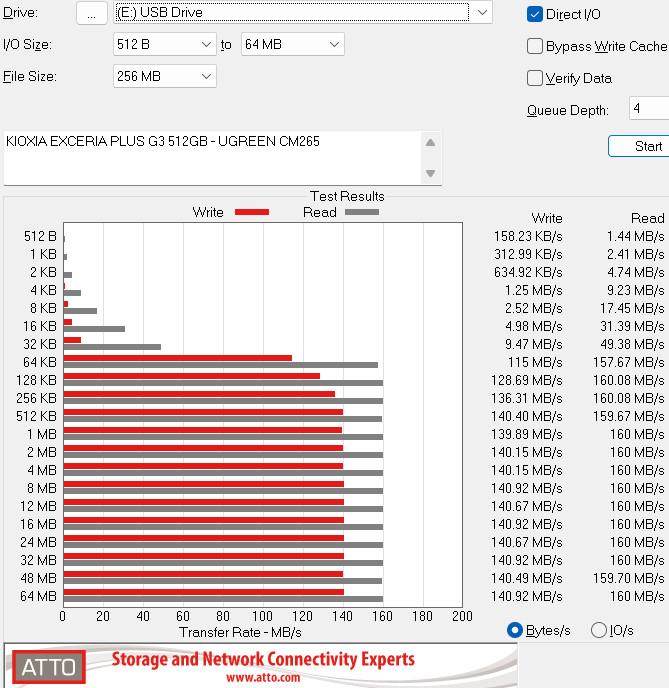
ATTO Disk Benchmark — UGREEN CM265 | Reads plateau ~160 MB/s; Writes plateau ~140–141 MB/s from 256KB+
The gap between the ATTO plateau (160 MB/s read) and the CDM result (167–168 MB/s) is explained by CDM's test methodology — it uses larger sequential queues that can push slightly past the ATTO steady-state figure. Neither figure exceeds the card's specification, and both demonstrate that the Exceria Plus G3 is operating as designed when given an appropriate reader.
Reader Comparison: Side-by-Side Results
Metric |
Slow Reader (Genesys Logic USB 3.2 Gen 1) |
Fast Reader (UGREEN CM265) |
Advertised Max |
Seq Read (MB/s) |
~95 |
~167 |
210 |
Seq Write (MB/s) |
~85 |
~146 |
150 |
4K Rand Read (MB/s) |
~6.9 |
~8.1 |
— |
4K Rand Write (MB/s) |
~3.0 |
~4.1 |
— |
ATTO Read |
~90–91 MB/s |
~160 MB/s |
— |
ATTO Write |
~82–83 MB/s |
~140–141 MB/s |
— |
With the UGREEN CM265, the Exceria Plus G3 delivers ~167 MB/s read and ~146 MB/s write — 76% and 72% faster respectively than with a standard reader. The card is not the bottleneck; the reader is. Upgrading to a compatible high-speed reader is strongly recommended to unlock the card's actual capability.
The Exceria Plus G3 microSD launched on 25 October 2025 in Japan, with European markets targeted for Q4 2025 per Kioxia Europe's announcement. As of February 2026, the card remains primarily a Japan/APAC product with no confirmed US or UK retail listings.
Japan Street Prices (February 2026)
Channel |
Part Number |
Price (incl. 10% tax) |
Domestic retail — lowest (ECJOY/Kakaku) |
KMUH-C512G |
approx. 22,968 JPY (~125 Euro) |
Domestic retail — Yodobashi.com |
KMUH-C512G |
approx. 25,760 JPY (~140 Euro) |
Domestic retail — range (21 stores) |
KMUH-C512G |
22,968 - 27,530 JPY (125~140 Euro) |
Overseas retail (Rakuten/Kazamidori) |
LMPL3M512GG2 |
approx. 17,017 JPY (~92 Euro) |
Prices from Kakaku.com and Rakuten/Kazamidori, February 2026. All JPY prices include 10% consumption tax.
The domestic (KMUH-C512G) and international retail (LMPL3M512GG2) SKUs are physically identical products — same hardware, same EAN 4582761160521. The ~35% price gap reflects the overseas SKU being sold without Japanese domestic customer support or Japanese-language documentation. Buyers in Japan opting for the cheaper overseas SKU should be aware that warranty service routes through the original retailer rather than Kioxia Japan. Both carry the same 5-year limited warranty from Kioxia's perspective.
For context, the predecessor Exceria Plus G2 512GB (KMUH-A512G) sits at around 19,800 JPY on Kakaku.com — the G3 commands a 16-30% premium at domestic retail depending on the channel, a reasonable premium given the substantially improved write performance and A2 classification upgrade.
The Exceria Plus G3 microSD is not listed on Amazon US, Amazon UK, or major European retailers as of February 2026. Buyers outside Japan seeking this card will likely need to import via Japanese retailers. When the card becomes available in Western markets, pricing is expected to be higher relative to yen-converted prices due to regional distribution costs.
Compatible Card Readers
One of the more useful resources Kioxia publishes alongside the Exceria Plus G3 is an official card reader compatibility document ("Lists of Specific Card Readers and Tested Card Readers", last updated November 7, 2025). It draws a clear and important distinction between two categories of reader, reproduced here in full for buyer reference.
Specific Card Readers — For Maximum Advertised Speed
Kioxia designates exactly one reader as the "Specific Card Reader" for the Exceria Plus G3: the UGREEN CM265 (model numbers 35506 in white and 35622 in black). This is the reader against which the advertised 210 MB/s read / 150 MB/s write figures were validated in Kioxia's own test environment — and crucially, the same reader used in our Phase 2 benchmarking above, where we recorded 167 MB/s read and 146 MB/s write.
Kioxia's own caveat is worth stating plainly: these figures represent best values from a specific internal test environment; Kioxia does not warrant achieving those speeds in every setup. Reader firmware updates may also be required before benchmarking.
Reader Model |
Part Number(s) |
Performance Tier |
UGREEN CM265 |
35506 (White) / 35622 (Black) |
Max advertised speed |
Table 1 — Kioxia Specific Card Reader for Exceria Plus G3 (source: Kioxia official compatibility document, Nov 7 2025)
Tested Card Readers — Confirmed Faster Than SDR104
Kioxia also publishes a broader "Tested Card Readers" list: readers confirmed to deliver speeds exceeding the UHS-I SDR104 mode ceiling (100 MB/s read / 90 MB/s write), without necessarily reaching the full advertised maximum. This list covers ten manufacturers, giving buyers meaningful purchasing flexibility.
Notably, our Phase 1 Genesys Logic USB 3.2 Gen 1 reader does not appear on either Kioxia list — consistent with the ~95 MB/s results we observed, which narrowly exceed SDR104 read speeds but are not officially validated. Buyers seeking any confirmed performance uplift should work from the table below.
Manufacturer |
Model Number(s) |
UGREEN CM401 |
15251 / 80888 |
UGREEN CM185 |
50706 |
UGREEN CM868 |
55886 |
Anker |
A8328 |
Belkin |
AVC009-V2 / AVC007-V2 |
Delkin |
DDREADER-55 |
JNH |
CR-UD201 |
Lexar |
LRW450 / LRW500URB |
ProGrade |
PGM0.5 |
SanDisk |
SDPR3A8-0000 / SDPR5A8-0000 / SDDR-B731 |
Silicon Power |
SPU3AT5REDEL300K |
SUNEAST |
SE-RWMASDU2H3D2 / SE-RWMASDU1S1D2 |
Team Group |
X0016YM22X |
TP-Link |
UA430 / UA430C / UA430D |
Table 2 — Kioxia Tested Card Readers for Exceria Plus G3 (source: Kioxia official compatibility document, Nov 7 2025)
For the full advertised 210/150 MB/s experience, only the UGREEN CM265 is officially validated by Kioxia. For a confirmed-faster-than-SDR104 result with more reader choice, any reader in Table 2 is Kioxia-approved. The compatibility list is updated periodically — check the latest version at kioxia.com before purchasing.