Kioxia Exceria Plus G3 512GB microSD
3. Conclusion
With the UGREEN CM265 in the loop, the Exceria Plus G3's value proposition becomes considerably more compelling. At ~167 MB/s read and ~146 MB/s write, the card approaches the advertised 210/150 MB/s ceiling as closely as the UHS-I bus architecture practically allows, and substantially outpaces the Samsung Pro Plus and SanDisk Extreme Pro at comparable price points in sequential write performance.
The UGREEN CM265 itself retails for less than 10 Euro (we found it around 8 Euro + Shipping) — a relatively modest incremental investment that transforms the card from a standard UHS-I performer into a near-ceiling one. For users who regularly transfer large volumes of RAW images or 4K footage, the time saved per session rapidly justifies that outlay.
For casual users who do not transfer files frequently, or who use the card primarily in-device (camera, smartphone, drone), the fast-reader advantage is irrelevant — the card will operate at device-limited SDR104 speeds regardless. In those scenarios, the G3 competes on write endurance, A2 app performance, and build quality rather than raw throughput.
From a cost-per-gigabyte standpoint, the 512GB tier remains a rational choice: it offers a better per-GB rate than the 1TB model at this stage of the product life cycle, without the diminishing-returns pricing that typically hits the largest capacity tier.
Verdict
With both test phases complete, the Kioxia Exceria Plus G3 512GB earns a stronger recommendation than its slow-reader numbers alone would suggest. Paired with the UGREEN CM265, it delivers approximately 167 MB/s sequential read and 146 MB/s sequential write — a 76% and 72% uplift respectively over a standard reader, and performance that comfortably leads the mid-range UHS-I pack on write speeds. The flat ATTO profile and consistent results across five CDM versions confirm this is a card with a well-tuned firmware stack, not a product coasting on spec sheet padding.
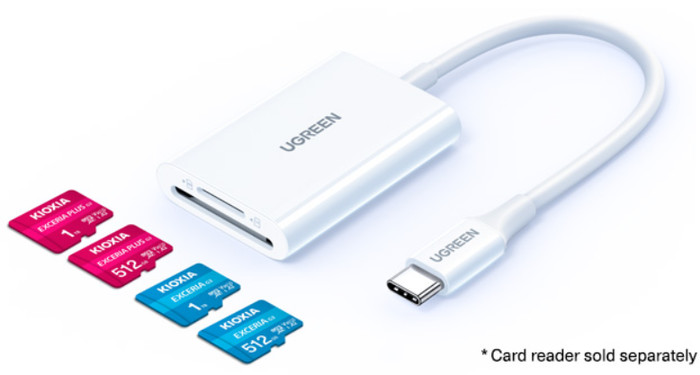
The key caveat remains unchanged: that performance requires a compatible high-speed reader. Without one, the G3 delivers around 95/85 MB/s — respectable and stable, but not differentiated from cheaper alternatives. Buyers who understand this going in and are willing to invest in the appropriate reader will be rewarded. Those expecting the headline figures from a standard laptop card slot will be disappointed. For content creators, serious hobbyist photographers, and anyone building a high-throughput microSD workflow from the ground up, the Exceria Plus G3 512GB is among the strongest options in its class.

Final Scores
Category |
Score |
Performance |
8.5 / 10 |
Value for Money |
7.5 / 10 |
Build Quality |
10 / 10 |
Reader Ecosystem |
8 / 10 |
Overall |
9 / 10 |
Pros
- ~167 MB/s read / ~146 MB/s write with the UGREEN CM265 — class-leading write performance for UHS-I
- Remarkably consistent across five CDM versions and ATTO; no throttling observed
- Strong random 4K read (~8.1 MB/s) and write (~4.1 MB/s) with fast reader — well beyond A2 minimums
- Official 5-year limited warranty — generous for a consumer microSD card
- Best-in-class durability spec: IPX7 waterproof, 5-metre drop test, ISO7816-1 X-ray proof, ESD +/-15 kV immunity, electrical fuse for overheating prevention
- Wide -25 to 85 deg C operating range; suitable for extreme cold and hot environments
- SD Adapter LADP1 included in the box; no separate purchase needed
- Kioxia publishes an official reader compatibility list: 14+ tested readers from 10 brands confirmed faster than SDR104
Cons
- Headline 210 MB/s read not reached in testing — 167 MB/s practical ceiling with the CM265 in our environment
- Standard-reader performance (~95/85 MB/s) is not differentiated from cheaper UHS-I U3 alternatives
- Only one reader (UGREEN CM265) officially validated for maximum advertised speed — adds small cost to the total package
- 64GB and 128GB variants carry lower write speeds (90/65 MB/s specific reader, vs 150/90 MB/s for 256GB+)