
be quiet! Dark Rock Pro 6
3. Tests
- CPU: AMD Ryzen 9 7950X
- Thermal Paste: Noctua NT-H2 thermal compound
- Open Case: StreaCom BC1 V2 Bench Table
- Motherboard: Asus ProArt X670E-CREATOR WIFI with 3702 BIOS
- Memory: 2x24GB Crucial DDR5-6000 CL48 (EXPO Profile)
- PSU: be quiet! Dark Pro 13 1300Watt
- Main Storage: Samsung 980Pro 1TB
- VGA: MSI GeForce RTX 4090 SUPRIM X 24G
- Operating system: Windows 11 x64 + latest motherboard/AMD chipset drivers installed
- Software: OCCT Enterprise Edition (2 sec interval monitor)
- Ambient room temperature ~ 24 Celsius (with AC climate control) - Environment Temperature measurements: Precision Gold N09AQ Envirometer Meter
We performed four tests depending on the CPU TDP load that can be set under Bios-> AI Tweaker-> Precision Boost Overdrive->AMD Eco Mode->
- cTDP 65Watt (real 90Watt)
- cTDP 105Watt (real 145watt)
- cTDP ~ 222Watt (via PBO at auto)
while we set the following voltages for all tests.
- CPU Core Voltage: Auto
- CPU SOC Voltage: 1.25V
- CPU VDDIO / MC Voltage: Auto
- Misc Voltage: 1.10V
At the OCCT software, we performed the Stability Test->CPU Test 15mins duration with various settings to get the maximum thermal production from the AMD 7950X.
Tests Disclaimer: Despite placing CPU voltages manually, the motherboard may supply the CPU with slightly different voltages, resulting in some cases higher temperatures that also result in higher working temperatures. Our results are valid with the above test system and using other variations may result in different results. Using other stress test software may also introduce different test results.
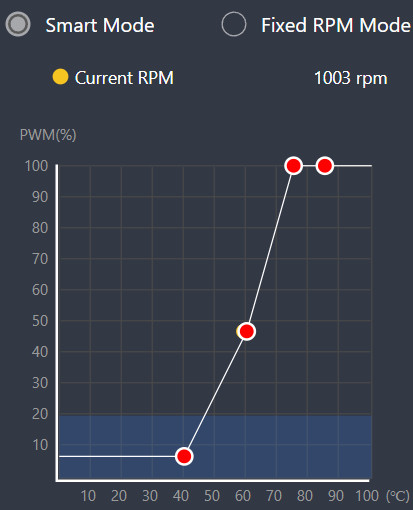
Before each run, we clean the CPU surface with 95% isopropyl alcohol and paper roll and we apply each thermal paste with the same methodology (central dot, small X lines, and small dots) to cover the full surface of the CPU area. All of our tests are done with the default Asus PWM curve fan.
Starting from the low 65watt AMD Eco TDP, we used the following OCCT settings
- Instruction Set: Auto
- Data Set: Large
- Mode: Normal
- Load Type: Variable
- Thread Settings: Auto
At light loads, the Dark Rock Pro 6 in Performance (P) mode with the stock 0mm AMD mounting position scores an impressive 53.11°C, placing it 8th overall in a field that includes large 360mm and 420mm AIOs. Only premium liquid coolers from Arctic and be quiet!'s own Light Loop and Silent Loop 3 beat it. Switching to P mode at the −8mm position yields 54.36°C — still excellent. In Quiet (Q) mode, temperatures rise to 59.12°C (0mm) and 59.49°C (−8mm), which is entirely expected given the fans are largely stopped at this power level. The trade-off for near-complete silence is modest and very acceptable for a low-load scenario.
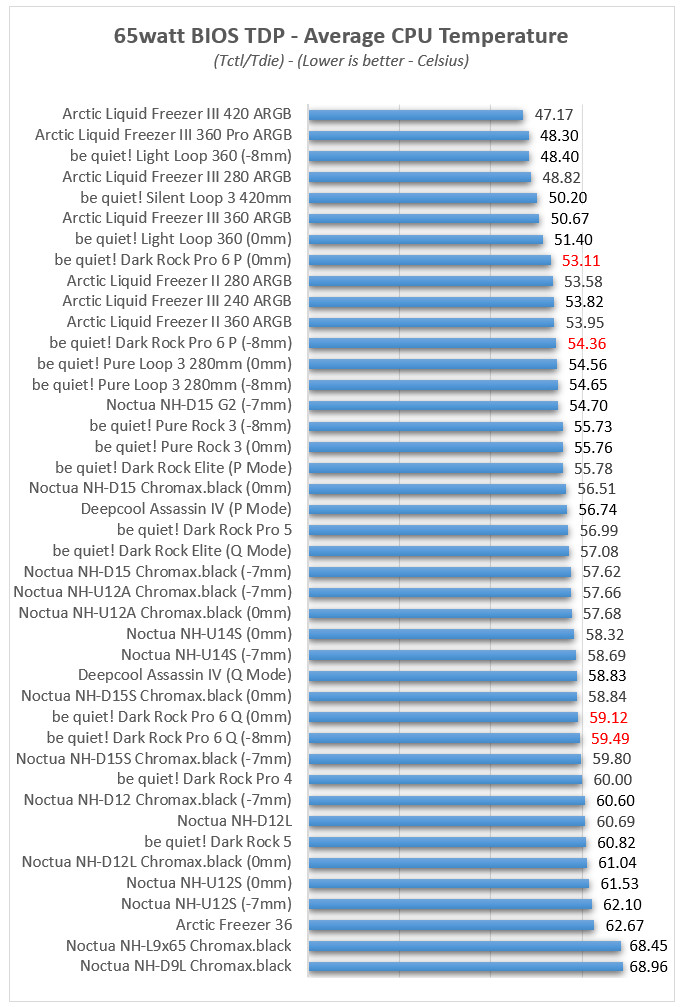
Notably, at 65W the Dark Rock Pro 6 in P mode outperforms direct air cooling rivals including the Noctua NH-D15 G2, both Deepcool Assassin IV modes, and its own predecessor, the Dark Rock Elite in P mode (55.78°C).
At the 105watt AMD Eco TDP setting, we used the following OCCT settings
- Instruction Set: Auto
- Data Set: Large
- Mode: Normal
- Load Type: Variable
- Thread Settings: Auto
The mid-load scenario is where the Dark Rock Pro 6 begins to assert itself convincingly among air coolers. In P mode at the −8mm mounting position, it reaches 64.16°C, placing it just behind the top-tier 360mm and 420mm AIOs and ahead of every competing air cooler in the chart, including the Noctua NH-D15 G2 (66.30°C) and the Dark Rock Elite in P mode (66.75°C). The P mode at 0mm follows closely at 65.40°C.
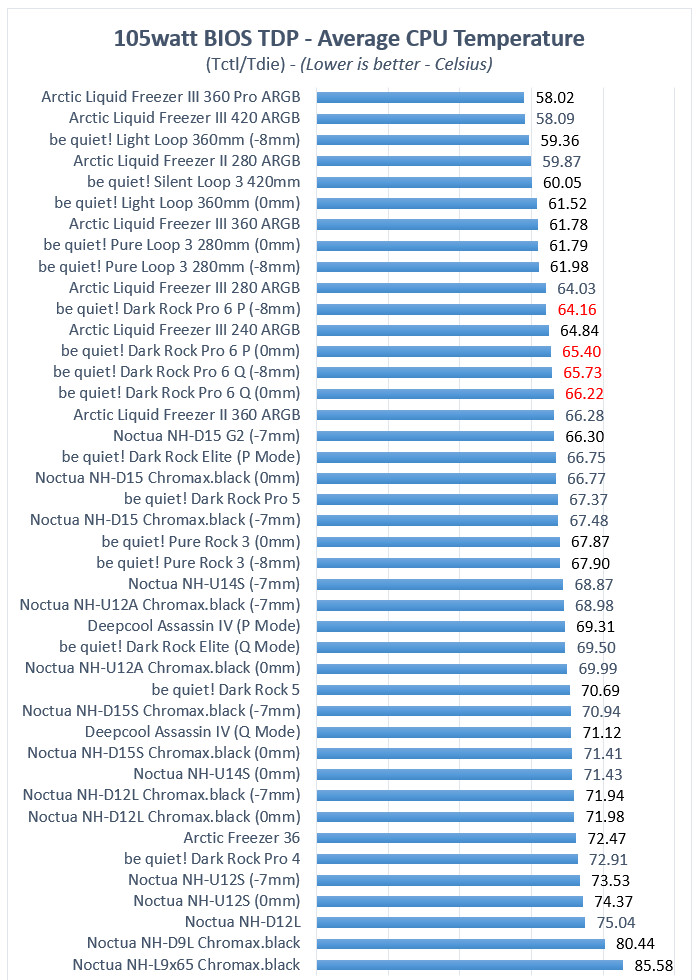
Even in Q mode — with fans partially or fully stopped below 40% PWM — the cooler manages 65.73°C (−8mm) and 66.22°C (0mm), figures that rival the Dark Rock Elite running in full Performance mode. This speaks volumes about how effective the passive and semi-passive operation is, even at 105W.
At the 222watt AMD TDP setting, we used the following OCCT settings
- Instruction Set: SSE
- Data Set: Small
- Mode: Extreme
- Load Type: Steady
- Thread Settings: Auto
At extreme loads, where thermal headroom separates competent coolers from great ones, the picture becomes more nuanced. The Dark Rock Pro 6 in P mode at the −8mm mounting position records 92.25°C, placing it among the top air coolers but behind the Noctua NH-D15 G2 (90.01°C) and the Dark Rock Elite in P mode (90.05°C). Q mode at −8mm scores 92.76°C, while P mode at 0mm is 93.02°C and Q mode at 0mm is 93.49°C.
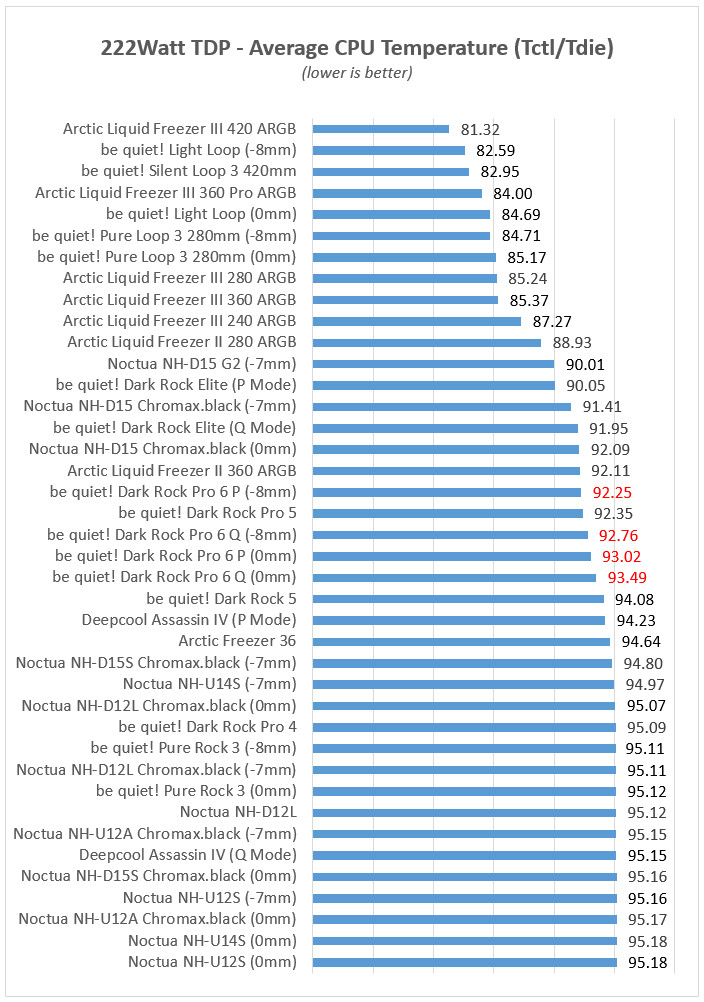
These results suggest that at sustained extreme loads the Dark Rock Pro 6 sits in a competitive but not dominant position among top-end air coolers — trailing the NH-D15 G2 and the Dark Rock Elite by a few degrees. At 222W, liquid cooling clearly takes the lead, with AIOs commanding a 10–12°C advantage.
The normalized efficiency index — which accounts for actual CPU package power consumed rather than nominal TDP — tells a more nuanced story. The Dark Rock Pro 6 in P mode at the −8mm mounting position achieves an index of 0.4156, placing it among the most efficient air coolers tested, ahead of the Arctic Liquid Freezer II 360 ARGB (0.4190), the Dark Rock Pro 5 (0.4219), and the Dark Rock Elite in Q mode (0.4142). Only the Dark Rock Elite in P mode (0.4056) and a handful of premium AIOs score better.
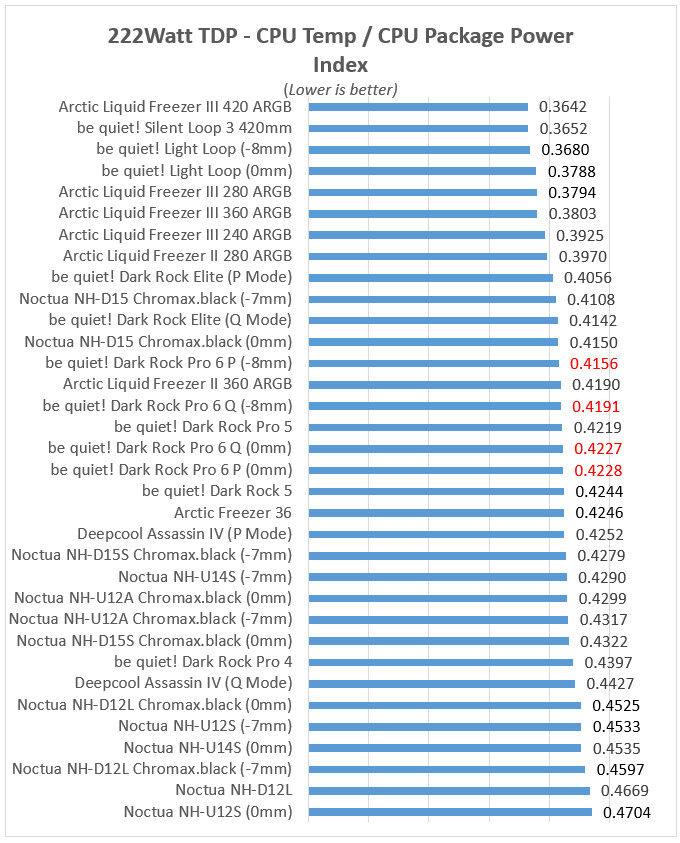
This means the Dark Rock Pro 6 is extracting very strong efficiency from the CPU relative to the heat it has to dissipate — a hallmark of a well-optimized cooler rather than one that simply brute-forces performance with maximum fan noise.