
Toshiba Storage Trends 2026
As we approach 2026, the global storage landscape is undergoing a profound transformation, driven by an unprecedented surge in data creation. The rapid rise of generative AI, the proliferation of high-value data, and the expansion of enterprise and surveillance environments are fuelling demand for greater storage capacity, improved efficiency, and enhanced reliability. For Toshiba and its partners, these trends present both significant opportunities and challenges as the industry adapts to the new era of data growth.
AI and Hyperscale - The Engines of Storage Demand
The main driver of storage demand in 2026 is the explosive growth of AI workloads, alongside the continued expansion of cloud computing and IoT. The International Data Corporation’s market forecasts indicate that global data storage requirements will reach nearly 20,000 exabytes by 2029[1], almost double the capacity needed in 2025. Advancements in both generative and agentic AI are generating vast volumes of data that must be stored, processed, and retained for regulatory or analytical purposes.
According to TrendForce, supply shortages for nearline HDDs have led to lead times stretching from a few weeks to a year[2]. While some cloud service providers are considering SSDs, particularly QLC SSDs, for cold data storage, HDDs remain indispensable for cost-efficient online data storage, typically backup files and archival data.
In the data centre environment, HDDs and SSDs serve complementary, not competing, roles. SSDs deliver superior speed for workloads requiring rapid random read/write operations, while HDDs offer a significantly lower cost per terabyte, making them ideal for large-scale sequential storage and archiving. Using SSDs solely for data archiving would be an inefficient use of resources. AI applications rely on massive volumes of data, with SSDs handling processing and HDDs handling archiving.
Surveillance and AI: New Demands, New Solutions
The surveillance market is undergoing a rapid transformation, driven by the integration of AI-powered video analytics and the increasing demand for high-resolution, always-on monitoring. These advancements are creating new requirements for storage solutions, demanding not only greater capacity but also higher performance and reliability to support real-time analytics and long-term data retention.
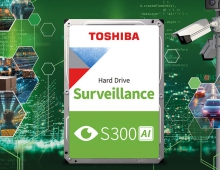
Toshiba’s recently introduced S300 AI HDDs are purpose-built to meet the rigorous demands of modern surveillance environments. Available in capacities ranging from 8TB to 24TB, these drives deliver sustained transfer speeds of up to 309MB/s, ensuring smooth capture and playback of high-resolution video streams. With a robust annual workload rating of 550TB and an impressive mean time to failure (MTTF) of 2.5 million hours, the S300 AI is designed for 24/7, mission-critical operation.
Crucially, the drives support up to 64 camera streams and 32 AI analysis streams simultaneously, making them ideal for large-scale, AI-driven surveillance systems that require both high throughput and reliability. By combining high capacity, performance, and durability, the S300 AI HDDs provide a comprehensive storage solution that empowers organisations to fully leverage the benefits of advanced video analytics and meet the challenges of next-generation surveillance.
HDDs Still Dominant and Evolving
Despite ongoing innovation, the industry’s reliance on the established 3.5-inch SAS/SATA HDD standard remains strong. This standardisation supports long-term, stable infrastructure investments and simplifies upgrades and integration, making it difficult for alternative form factors and interfaces to gain traction. Gartner forecasts that by 2026, HDDs will represent 68% of total shipped capacity[3], with most shipments being high-capacity, 3.5-inch nearline HDDs tailored to the needs of cloud and enterprise data centres.
On the technical front, while technologies such as multi-actuator drives, NVMe or Ethernet interfaces for HDDs, and shingled magnetic recording (SMR) have been introduced, they have yet to achieve widespread adoption.
Toshiba continues to invest in R&D and manufacturing to deliver higher-capacity drives with improved energy efficiency and reliability. A recent breakthrough is Toshiba’s verification of 12-disk stacking technology, which combines Microwave-Assisted Magnetic Recording (MAMR), enabling 40TB-class HDDs in the standardised 3.5-inch format by 2027. This innovation involves new dedicated components in the stack and the replacement of traditional aluminium substrates with glass, resulting in improved mechanical stability and in-plane accuracy, higher density, and greater reliability. Toshiba is also investigating the integration of 12-disk stacking with next-generation Heat-Assisted Magnetic Recording (HAMR) for even higher capacities.
Environmental Responsibility and Energy Efficiency
Sustainability will remain a core priority for data centre operators and storage vendors. As the number of data centres grows, so does the scrutiny of their energy consumption and environmental impact. Energy efficiency is a key design priority in HDD development; modern HDDs typically draw about 9 to 10 Watts, regardless of the capacity. As capacities increase, the actual power-per-terabyte drops from 1W/TB for 10TB drives to less than 0.4W/TB for 24TB drives. Future generations are expected to push this ratio even lower.
To achieve these gains, Toshiba leverages helium-filled enterprise drives to minimise friction and power consumption. Helium, being roughly one-seventh the density of air, allows platters to spin with less resistance and generate less heat. Toshiba’s HDD Innovation Lab in Düsseldorf, Germany, provides benchmarking and power analysis services, helping partners optimise storage configurations for performance and energy efficiency. Recent lab reports show that modern HDD systems can achieve active power draws under 600W for 60-bay JBODs, with efficient cooling and high throughput.
Benchmarking, Testing, and Knowledge Sharing
As storage architectures become more complex and data demands continue to rise, the need for expert guidance and rigorous validation is greater than ever. In 2026, Toshiba’s HDD Innovation Lab is set to become an indispensable resource for customers and partners navigating this rapidly evolving landscape.
The HDD Innovation Lab’s expertise in evaluating and optimising HDD setups for SAN, NAS, and surveillance applications will be critical as organisations seek to maximise performance, energy, and reliability. By providing proof-of-concept testing, benchmarking, and energy-consumption analysis, the HDD Innovation Lab enables customers to make informed decisions and deploy storage solutions tailored to their unique requirements.
Through loan samples, live demonstrations, and the publication of detailed lab reports, the facility fosters a culture of knowledge sharing and innovation. Its collaborative approach ensures customers have access to the latest insights and best practices, making it an essential partner in the journey toward next-generation storage.
Looking ahead, the importance of the HDD Innovation Lab is only expected to grow. With anticipated growth in data centre deployments and the increasing complexity of storage environments, expansion of the facility is a strong possibility.
Summary: Challenges and Opportunities
The storage industry in 2026 is adapting to unprecedented levels of demand and innovation. As data volumes continue to soar, the ability to deliver scalable, sustainable, and reliable storage will be crucial. HDDs remain the backbone of cost-effective, long-term storage and will continue to play a vital role in the evolving storage landscape.
Toshiba remains committed to advancing high-capacity, energy-efficient HDDs, through ongoing R&D investment, increased production capacity, and customer-centric storage solutions via its HDD Innovation Lab. Breakthrough technologies such as 12-disk stacking and advanced recording methods will enable new levels of density and efficiency, paving the way for next-generation storage solutions that meet the requirements of tomorrow’s data-driven world.